
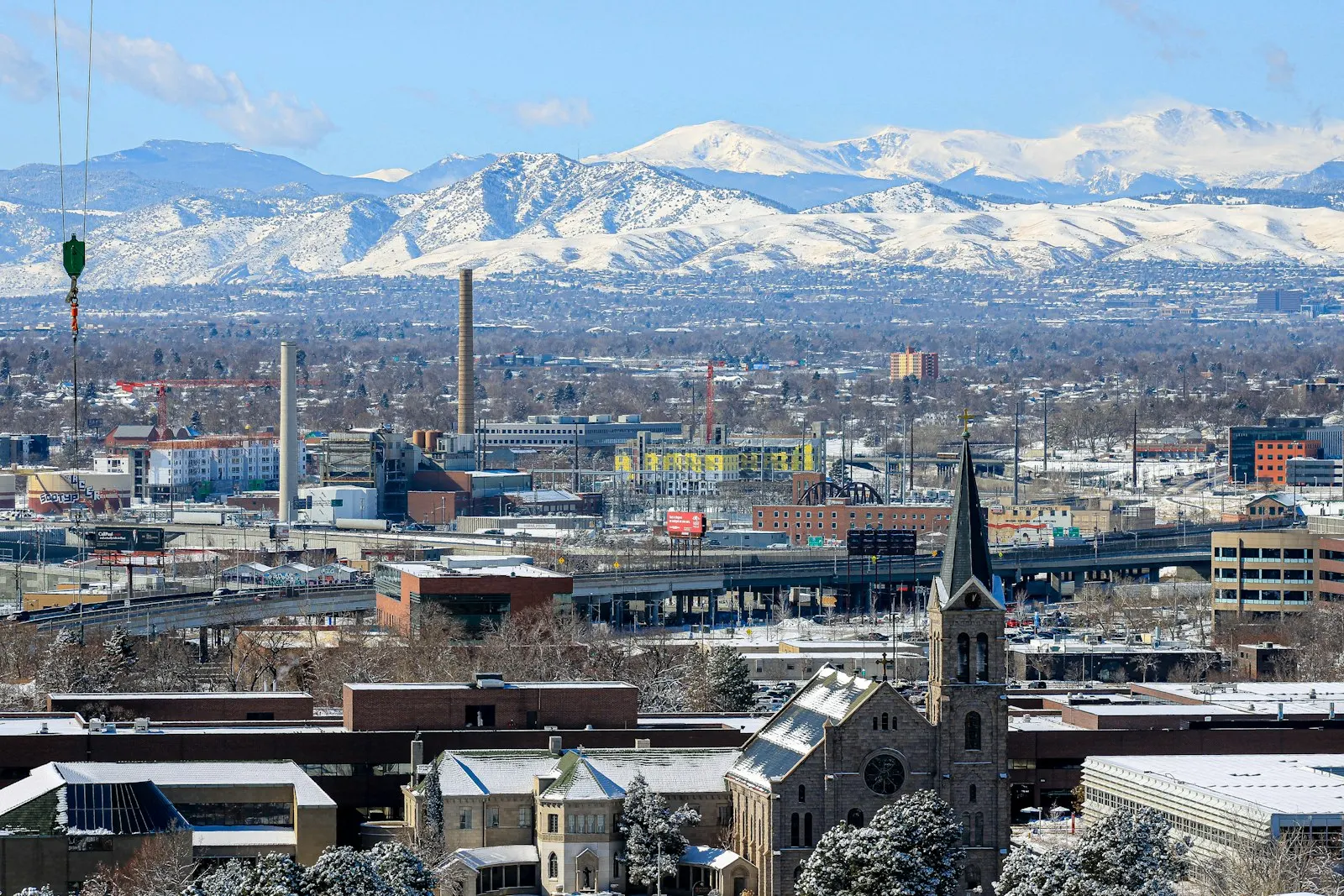
Monument to Longmont
Front Range Plumbing Service Areas
Thirty cities, roughly 2,000 feet of elevation change, and freeze dates that swing almost a month end to end. Every one of them gets its own page, its own timing bar, and its own service guides.
- 30 city guides
- Live freeze timing
- Local housing quirks
- One quote form
The corridor, top to bottom
This service area runs the length of the northern Front Range urban corridor: Monument on the Palmer Divide at the south end, Longmont in the St. Vrain valley at the north, and everything between. Denver sits in the middle at exactly a mile. Golden and Boulder press against the foothills. Brighton, Firestone, and Frederick spread east onto the plains.
Geography does real work here. Monument's 6,961 feet catch first frost in late September while Longmont, nearly 2,000 feet lower, usually holds out until early October. Boulder and Monument can take 80 to 100 inches of snow in a season; Brighton and the Carbon Valley towns often see less than half that. Same corridor, genuinely different winters.
Housing tells the other half of the story. Denver, Englewood, and Littleton carry pre-war stock with galvanized supply and clay laterals. Northglenn went up almost entirely in the early 1960s. Erie and Firestone are mostly younger than the iPhone. Plumbing advice that ignores those differences is just noise with a city name pasted on.
What's on every city page
Each city gets a full guide: how its housing stock actually fails, what its water district does to fixtures, how mountain proximity and elevation shape its weather, and a live season bar showing where today sits against that city's historical first freeze, first snow, and last spring freeze. Current conditions come straight from the National Weather Service for that city's coordinates.
Below that sit five service guides written specifically for that city: drain cleaning, water heater repair, sewer line repair, emergency plumbing, and frozen pipe repair. Thirty cities, five services, and no two pages built from the same paragraph.
| City | Elevation | Typical first freeze | Snow in a season |
|---|---|---|---|
| Monument | 6,961 ft | Late September | 80 to 100 inches |
| Castle Rock | 6,224 ft | Late September | 60 to 75 inches |
| Denver | 5,280 ft | Early October | 45 to 55 inches |
| Boulder | 5,318 ft | Early October | 80 to 95 inches |
| Longmont | 4,979 ft | Early October | 35 to 50 inches |
Find your city below
Cities are listed south to north, the way the corridor actually runs. Each entry shows its region, elevation, historical first-freeze timing, and typical seasonal snowfall, so you can see at a glance how your town compares to the neighbors you're always trading contractor recommendations with.
Not sure which page fits? Pick the city you get mail in. Water districts and freeze timing follow municipal lines more reliably than the neighborhood name on a real estate listing.
The whole corridor
Every city, its own page
Monument
Palmer Divide / Tri-Lakes · 6,961 ft · first freeze late September · ~80-100″ of snow a year
→Castle Rock
Palmer Divide north slope · 6,224 ft · first freeze late September · ~60-75″ of snow a year
→Parker
Cherry Creek corridor, southeast metro · 5,869 ft · first freeze early October · ~50-65″ of snow a year
→Lone Tree
I-25 south corridor · 5,860 ft · first freeze early October · ~50-60″ of snow a year
→Highlands Ranch
South metro master-planned community · 5,920 ft · first freeze early October · ~55-70″ of snow a year
→Centennial
South-central metro · 5,834 ft · first freeze early October · ~50-65″ of snow a year
→Littleton
South Platte valley, historic south metro · 5,351 ft · first freeze early October · ~45-60″ of snow a year
→Englewood
Inner south metro · 5,371 ft · first freeze early October · ~45-55″ of snow a year
→Greenwood Village
Denver Tech Center corridor · 5,397 ft · first freeze early October · ~48-60″ of snow a year
→Denver
Mile High City, metro core · 5,280 ft · first freeze early October · ~45-55″ of snow a year
→Aurora
Eastern metro plains · 5,403 ft · first freeze early October · ~45-60″ of snow a year
→Commerce City
Northern industrial corridor · 5,164 ft · first freeze early October · ~40-55″ of snow a year
→Brighton
Northern plains, ag heritage · 4,984 ft · first freeze early October · ~35-50″ of snow a year
→Thornton
North metro corridor · 5,351 ft · first freeze early October · ~45-58″ of snow a year
→Northglenn
North metro, planned 1960s community · 5,463 ft · first freeze early October · ~45-58″ of snow a year
→Federal Heights
North metro, compact and dense · 5,381 ft · first freeze early October · ~45-58″ of snow a year
→Westminster
Northwest metro · 5,384 ft · first freeze early October · ~48-62″ of snow a year
→Broomfield
US-36 corridor, city and county · 5,420 ft · first freeze early October · ~50-65″ of snow a year
→Arvada
Northwest metro, Ralston Valley · 5,344 ft · first freeze early October · ~50-68″ of snow a year
→Wheat Ridge
West metro, greenhouse heritage · 5,459 ft · first freeze early October · ~48-62″ of snow a year
→Golden
Foothills gateway, Clear Creek canyon mouth · 5,675 ft · first freeze late September · ~60-80″ of snow a year
→Lakewood
West metro, Green Mountain · 5,518 ft · first freeze early October · ~50-65″ of snow a year
→Erie
Northern tier boom town · 5,130 ft · first freeze early October · ~40-55″ of snow a year
→Lafayette
East Boulder County · 5,236 ft · first freeze early October · ~45-60″ of snow a year
→Louisville
East Boulder County · 5,335 ft · first freeze early October · ~48-62″ of snow a year
→Superior
US-36 at the foothills bench · 5,528 ft · first freeze early October · ~50-65″ of snow a year
→Boulder
Foothills city at the Flatirons · 5,318 ft · first freeze early October · ~80-95″ of snow a year
→Longmont
St. Vrain valley, northern anchor · 4,979 ft · first freeze early October · ~35-50″ of snow a year
→Firestone
Carbon Valley · 4,970 ft · first freeze early October · ~35-50″ of snow a year
→Frederick
Carbon Valley · 5,000 ft · first freeze early October · ~35-50″ of snow a year
→Questions we actually get
Quick answers
Why these thirty cities specifically?
They form the continuous urban corridor along the northern Front Range, every community from Monument to Longmont with meaningful population. It's one connected market of homeowners sharing similar weather patterns and contractor networks, but with enough local variation that generic metro advice fails.
What if my town isn't on the list?
Send a quote request anyway and name your town. Plenty of surrounding communities share housing eras and water districts with cities we do cover, and the guidance often transfers cleanly. If enough requests come from one place, it earns its own page.
How accurate are the freeze dates?
They're historical approximations for each city's elevation and setting, useful for planning winterization rather than predicting any specific night. Colorado weather delights in exceptions. Treat the season bar as a scheduling nudge, and let the live National Weather Service conditions handle the actual forecast.
Find your city, then tell us what's wrong.
Local guidance beats generic advice, and it takes about a minute to get a real answer started.
Get My Free Quote