
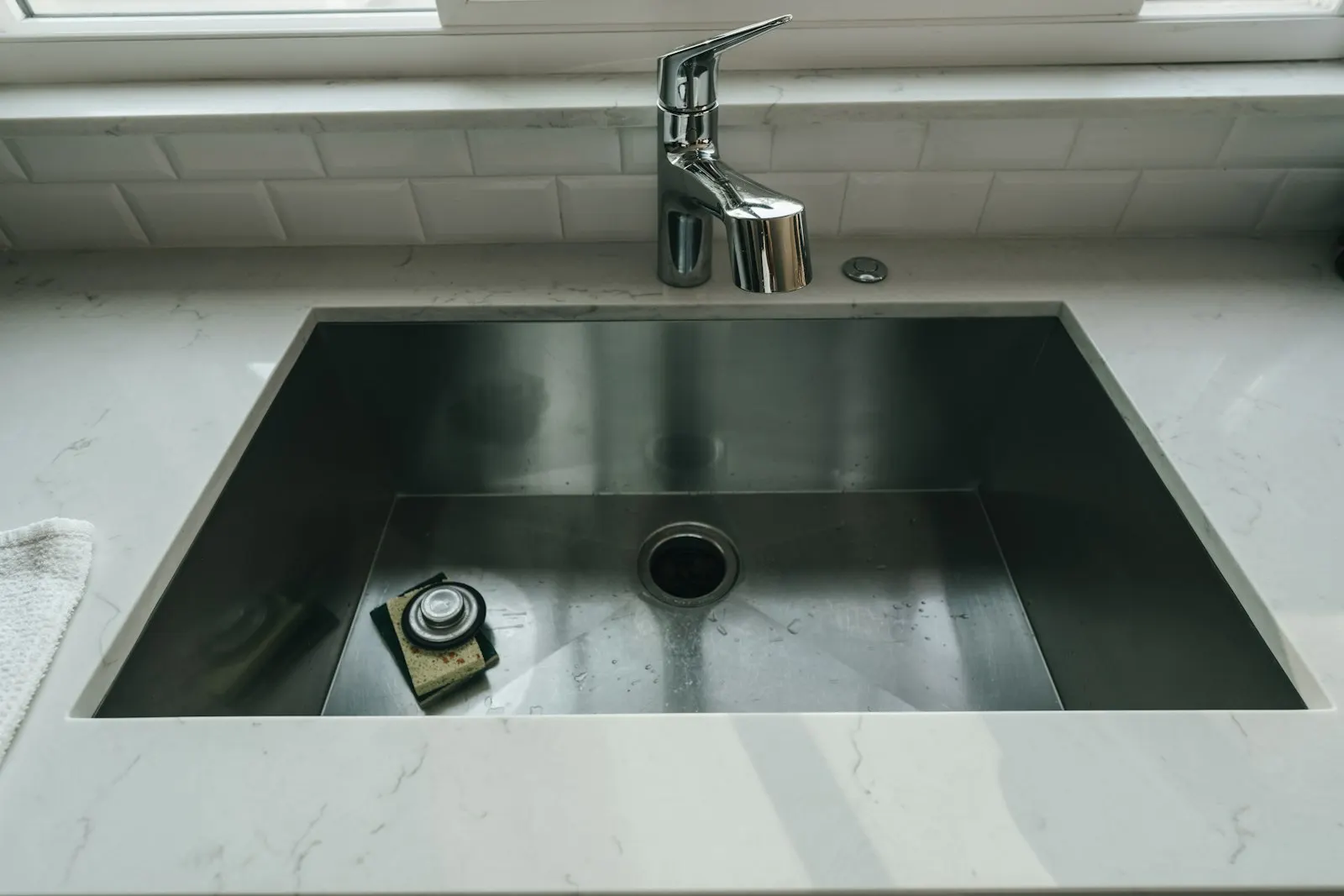
Kitchen and lavatory drains
Clogged Sink Repair Denver
Kitchen & Bathroom Sink Clog Removal
One bowl fills while the other gurgles. Water rises on the disposal side when the dishwasher drains. Most kitchen and bath sink clogs live within six feet of the basket strainer, in the P-trap or the trap arm behind the cabinet wall, and that changes everything about the fix.
- P-trap and trap arm work
- Disposal-side backups explained
- When it's really the vent
- Honest Front Range costs
Most sink clogs live in the first six feet
A kitchen sink drains through a basket strainer, a short tailpiece, and then a P-trap that holds a couple of inches of standing water on purpose. That water is the seal keeping sewer gas out of your kitchen. It's also the low point where every bit of bacon fat, coffee ground, and rice grain slows down and decides whether to keep moving.
Bathroom sinks fail differently. The lavatory drain is smaller, an inch and a quarter on most older builds, and the pop-up stopper hangs down into it with a horizontal pivot rod poking through the back of the tailpiece. Hair and toothpaste wrap around that rod and build a felt-like plug. Pull the stopper and half the time the clog comes out with it.
Past the trap sits the trap arm, the horizontal run back to the wall stub-out. That's where slope matters. In pre-1970 kitchens around Englewood and Wheat Ridge that arm is often galvanized steel, and decades of scale have narrowed an inch-and-a-half pipe down to something closer to a garden hose.
| What you see | Where it probably is | What clears it |
|---|---|---|
| One bowl backs up, rest of the house is fine | P-trap or tailpiece | Pull the trap, clean it by hand |
| Water rises on the disposal side only | The wye below the unit | Clear the unit first, then the branch |
| Both bowls fill and the sink gurgles | Trap arm or branch line inside the wall | Small cable machine, 25 feet or so |
| Lavatory drains slow and smells sour | Pop-up rod and stopper | Drop the pivot nut, pull the hair out |
| Drains fine until another fixture runs | The vent, not the drain | Stack gets checked from the roof |
The disposal side is its own animal
On a double-bowl kitchen sink the disposal hangs off one side and dumps into a wye that ties back into the other bowl's waste. So a blockage downstream of that wye shows up as water climbing in the bowl you weren't even using. People run the disposal harder, which packs the plug tighter, then run hot water, which melts grease just enough to move the whole mess three inches and reset it solid.
If the unit hums and nothing turns, that's mechanical rather than a drain issue, and the disposal itself is where to start. If it spins freely and the bowl still fills, the trouble is past it.
Dishwashers complicate the story. The drain hose ties into the disposal inlet or a dedicated port on the tailpiece, and it has to rise into a high loop under the countertop, or through an air gap on the sink deck, before it drops. Without that loop, sink water siphons backward into the machine, and you get an inch of gray water standing in a dishwasher everybody blames on the appliance.
Water chemistry tilts the odds too. Central Weld and South Adams County supply carries enough hardness that soap bonds to pipe wall instead of rinsing away, so kitchen lines in Firestone, Brighton, and Commerce City scale from the inside out. Denver's snowmelt supply is soft and does none of that, which is one reason a 1954 bungalow off Federal can run its original trap arm for decades and still drain like new.
What it costs, and when to stop plunging
Cost tracks access and distance. A trap pull with a hand auger on a bathroom sink is about the cheapest drain call in the trade and commonly lands in the low hundreds along the Front Range. Running a small cable machine through a kitchen branch sits higher. If someone has to open a wall, cut into cast iron, or rebuild an S-trap that's been siphoning itself dry since the Eisenhower administration, you've left cleaning and entered repair, and the number moves with it.
Two things reliably inflate the bill. First is chemical drain opener sitting in the trap: a tech who opens a trap full of lye takes precautions that cost time, and some shops decline the visit outright. Second is a stripped or overtightened slip nut on old chrome tubulars. That brass-and-plastic assembly under a 1960s lavatory is thirty cents of parts and an hour of swearing.
Stop plunging when the water quits moving entirely, when the clog returns inside a day, or when a second fixture starts gurgling in sympathy. One slow sink is a sink problem. Two slow fixtures on the same wall is a branch problem. A whole floor draining slow is a main line question, and no amount of work under the cabinet touches it.
If one bowl backs up and everything else in the house drains normally, the problem sits within a few feet of that basket strainer, and a bucket, a wrench, and twenty minutes usually settle it. The second a neighboring fixture gurgles, put the tools down. That gurgle is air, and air means the blockage moved past your reach.
Need this handled this week?
Start a quoteKeep the trap clean and the strainer honest
Grease is the whole game in a kitchen, and not the visible kind you pour off a pan. It's the invisible kind riding in dishwater at 130 degrees, hitting a cold trap arm above an unheated crawlspace, and setting up like candle wax. Wipe pans with a paper towel before they hit the sink. Unglamorous, free, and it outperforms every bottle of enzyme cleaner sold on this corridor.
Bathroom sinks want the opposite attention: physical, not chemical. Every few months, drop the pivot nut behind the tailpiece, pull the pop-up, strip the hair off the rod, reseat it, and check that the clevis strap still lets the stopper seal. Five minutes, no parts, no smell.
And if a kitchen sink has been slow since the day you moved in, don't file it under personality. Slow from day one usually means a fitting problem, a flat trap arm, or a vent that was never tied in correctly, and snaking does not fix geometry. Have somebody look at it once, properly, instead of paying to cable it every spring. Neighbors in Wheat Ridge and Arvada working from the same 1950s floor plan often turn out to share the same original mistake.
Related work
More drains services
Clogged Toilet Repair
toilet blockages, running toilets, flange and wax ring failures, replacement
→Shower & Tub Drain Clogs
hair and soap blockages, slow tubs, pop-up assemblies, drum traps in old homes
→Garbage Disposal Repair
jammed or humming units, leaks at the flange, replacement sizing
→Hydro Jetting
high-pressure line scouring, grease mains, when jetting beats cabling
→Floor Drain Backups
basement floor drains, laundry standpipes, backwater valves
→Where we cover
Front Range cities we write for
Questions we actually get
Clogged Sink Repair: quick answers
Is chemical drain opener ever the right call on a sink?
Rarely, and it costs you options. Lye and sulfuric openers sit in the trap, cool off, and often stall right on top of the clog, so the next person has to open a trap full of caustic liquid. Some shops decline that job outright. Twenty minutes with a bucket and a wrench beats a bottle nearly every time on a sink.
The kitchen sink only backs up when the dishwasher runs. What's wrong?
The dishwasher drains into your kitchen waste line, so it's revealing a restriction that lighter flows slip past. Check the drain hose first: it should rise into a high loop under the counter before it drops. If the loop is right and the backup still happens, the branch line past the trap arm needs a small cable, not another rinse cycle.
How far can a homeowner reasonably get on a sink clog?
Farther than most people expect. Pulling a P-trap takes a bucket, channel-lock pliers, and a rag, and it solves a large share of single-fixture backups. A quarter-inch hand auger reaches the trap arm and the first few feet of branch. Past that you're feeding cable into a wall blind, and that's where a real machine and some experience earn their keep.
Sink still holding water?
Tell us what the other bowl does when you run the tap, and we'll point the request at the right kind of visit.
Get My Free Quote