
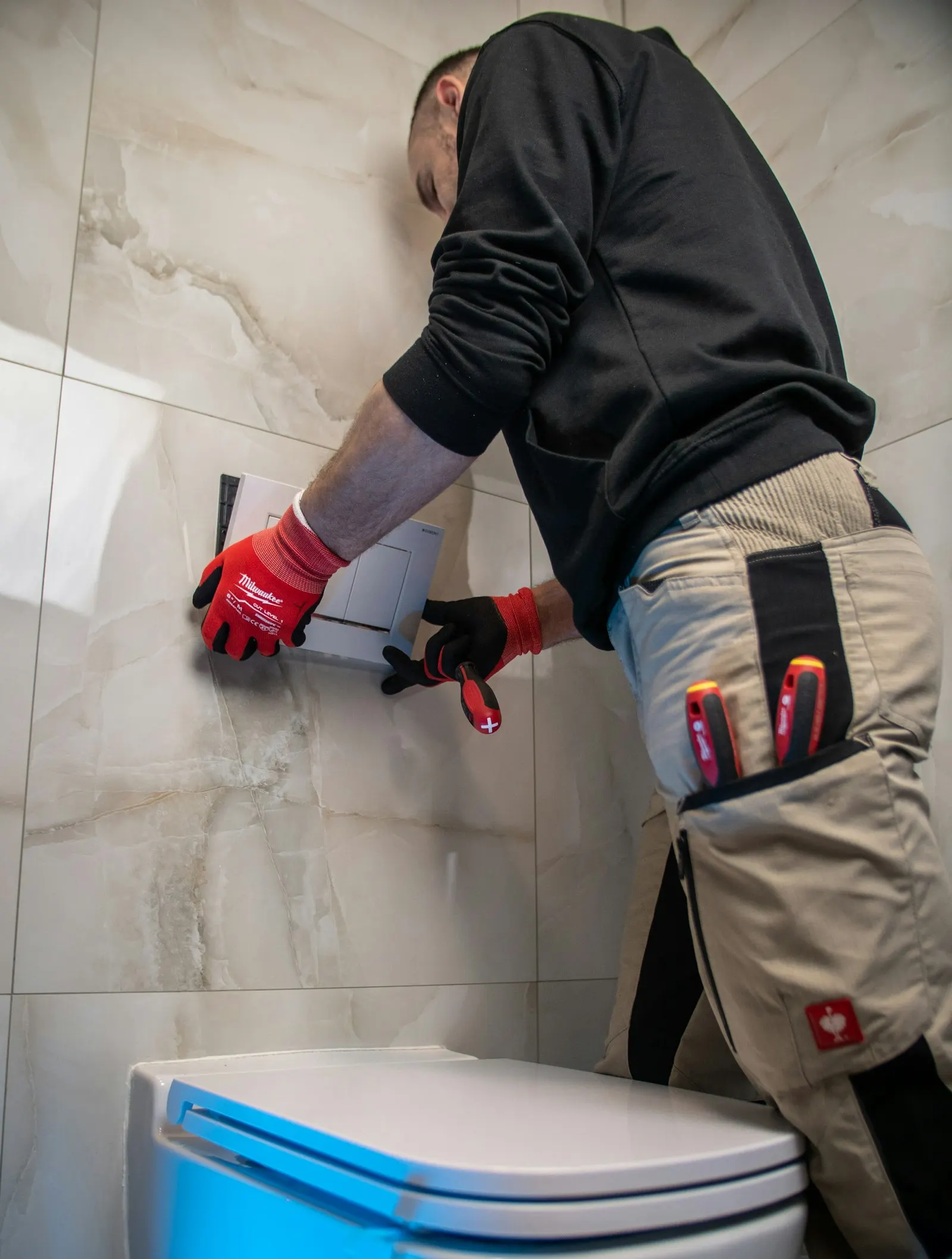
Toilets, flanges, and tank guts
Clogged Toilet Repair Denver
Toilet Clogs, Flange Repair & Replacement
The bowl fills to the rim and creeps down. Or it flushes weak and leaves half the paper behind. Toilets fail in a short list of predictable ways, and most of those fixes cost less than lunch. The trick is telling which failure you're looking at before you buy anything.
- Closet auger, not a plunger
- Flange and wax ring failures
- Fill valve and flapper fixes
- Repair or replace math
Start with what the bowl is telling you
A toilet complaint comes in two flavors. The bowl fills to the rim and seeps down slowly, which puts the blockage in the trapway or just past it. Or the water drops fast with a weak swirl and leaves solids behind, which usually means the flush isn't delivering enough water to begin with. Same phone call, opposite repairs.
Use the right plunger. The flange type, with a soft sleeve that folds out of the cup, seals inside the outlet so your effort moves water instead of air. A flat cup plunger built for a sink rim just makes a mess. If two hard sets of strokes get you nothing, switch to a closet auger: three feet of cable in a vinyl-sleeved crook, shaped to follow the trapway without scratching the china.
Then there's the category that never really clears. A toothbrush, a scrub sponge, a toy dinosaur, a wipe labeled flushable that is nothing of the sort. Hard objects lodge in the trapway and let just enough water past to fool you for a week. If a toilet clogs again within days of being cleared, assume something is parked in there and plan on pulling the fixture off the floor.
One more sorting question. Is it only this toilet, or is every drain in the house sluggish? If the tub gurgles when you flush, the toilet is the messenger and not the problem, and you're into main line territory instead.
Flanges, wax rings, and the wobble you keep ignoring
Under the bowl sits a closet flange, a collar bolted to the floor that anchors the toilet and marries it to the three or four inch drain below. A wax ring squashed between the bowl horn and that flange makes the seal. Wax doesn't wear out from water. It fails because the toilet moved.
So the wobble matters more than people think. A toilet that rocks a quarter inch under your weight works that wax like a hinge until it opens a path for water and sewer gas. The symptoms arrive in order: a faint sewer smell in the bathroom, then dark grout at the base, then a stain on the ceiling of the room below.
Flanges fail by material and by age. Cast iron flanges in pre-1970 Denver and Littleton homes rust through at the bolt slots, so the closet bolt tears up through rotten metal. PVC flanges on slab-on-grade builds in Erie and Castle Rock crack at those same slots instead. Either way the answer is a repair ring or a new flange, not a second wax ring stacked on the first. Doubling wax is the most common shortcut in the trade and it buys about a year.
Tile remodels create their own version of this. Add three-quarters of an inch of tile and mortar over the old floor and the flange now sits below the finished surface, asking the wax to bridge a gap it was never shaped to bridge. An extender ring fixes it in twenty minutes and saves the ceiling downstairs.
- If the toilet rocksshim it and reset it on fresh wax now, before the leak starts rather than after
- If water pools at the base after every flushthe seal or the flange is done, and that toilet goes out of service today
- If the bowl drains slowly but the tank fills fineyou have a trapway blockage, not a flush problem
- If a stain appears on the ceiling belowpull the toilet the same week and look hard at the subfloor
Repair it or replace it? Run the numbers this way
Parts are cheap and toilets are not. A flapper runs a few dollars, a fill valve under twenty, a wax ring and bolts about the same, and all three together are one Saturday morning. Having somebody come out to auger a bowl or swap tank guts commonly lands in the low-to-mid hundreds along this corridor, depending on access and hour of day. Pulling and resetting a toilet with a new flange costs more, because it's really two jobs: the fixture comes off, the floor gets inspected, and whatever rotted under there gets dealt with honestly.
The replacement argument gets strong in three cases. A cracked bowl or tank, which is never repairable at any price. A pre-1994 three-and-a-half gallon guzzler you're already paying to auger twice a year. Or a bowl whose rim jets have scaled shut. On hard groundwater in Brighton, Commerce City, and the Weld County towns, mineral builds inside the rim channel where no brush reaches, and the flush loses the wall-scouring swirl it depends on. You can dissolve some of that. You cannot rebuild the channel.
A mid-grade toilet plus installation usually beats the third service call in eighteen months. And if the bathroom sits on a basement slab or the branch runs at marginal slope, put the money into a bowl with a big glazed trapway rather than the heated seat.
Need this handled this week?
Start a quoteA running toilet is a slow leak with a soundtrack
Flapper or fill valve, almost always. If the tank refills every few minutes with nobody home, the flapper is passing water into the bowl. Put a few drops of food coloring in the tank, wait fifteen minutes without flushing, and look in the bowl. Color in the bowl means the seat is shot.
If instead the valve hisses without shutting off, or shuts off and chatters back on a minute later, suspect the fill valve. Rubber diaphragms harden with age and mineral grit works under the seal. On groundwater systems that failure arrives sooner than it does in Denver, where soft mountain supply is genuinely easy on the parts. Swap the whole valve rather than rebuilding it, since the part costs less than a second trip to the hardware store.
Worth knowing about the third leak: tank-to-bowl bolts and the spud gasket between the tank and bowl. When those weep, water runs down the back of the china and puddles at the base, and everyone blames the wax ring. Dry the floor completely, then watch where the wet starts. Front or sides points at the seal. Behind the bowl points at the tank. Two minutes of patience saves an unnecessary reset.
Related work
More drains services
Clogged Sink Repair
kitchen and bathroom sink blockages, P-trap work, disposal-side clogs
→Shower & Tub Drain Clogs
hair and soap blockages, slow tubs, pop-up assemblies, drum traps in old homes
→Garbage Disposal Repair
jammed or humming units, leaks at the flange, replacement sizing
→Hydro Jetting
high-pressure line scouring, grease mains, when jetting beats cabling
→Floor Drain Backups
basement floor drains, laundry standpipes, backwater valves
→Where we cover
Front Range cities we write for
Questions we actually get
Clogged Toilet Repair: quick answers
Which plunger actually works on a toilet?
The flange type, with the soft rubber sleeve that folds out of the cup. It seals inside the toilet's outlet so your push moves water rather than air. A flat cup plunger is shaped for a sink rim and mostly splashes. Two firm sets of strokes should move something. If nothing gives, put the plunger down and pick up a closet auger.
My toilet flushes weakly but nothing is clogged. Why?
Look at the rim jets under the lip and the siphon jet at the bottom of the bowl. On hard groundwater north and east of Denver, mineral scale narrows those openings year by year and the flush loses the swirl that scours the bowl. Check the tank water level too, since a fill valve set low starves every single flush.
How do I know if the wax ring failed?
Water shows up at the base after a flush rather than while the tank refills, and the toilet usually rocks a little. A stale sewer smell often arrives first. Dry the floor completely and watch where the wet reappears. Front or sides points at the wax or the flange. Behind the bowl usually means tank bolts or the spud gasket.
Toilet acting up?
Describe the symptom, the age of the house, and whether it rocks, and we'll route the request accordingly.
Get My Free Quote