
Freeze guidance for creek-bottom Parker
Frozen Pipe Repair Parker CO
Pipe Thawing, Burst Repair & Freeze Prevention
Frozen pipe repair in Parker rarely starts where people expect. It starts in the floor of a bonus room over an unheated garage, or in the stud bay behind a washer on a garage wall, on a creek-bottom lot where cold air pooled hours before the forecast admitted it. Here's the pattern.
- Bonus-room floors freeze first
- Creek-bottom cold air pooling
- Safe thawing, no torches
- October prep that holds
The bonus room floor is Parker's first casualty
Builders here loved a bonus room over the garage, and they put a lot of them in through the 90s and 2000s. Great square footage. Terrible thermal neighborhood. That floor sits directly on top of an unheated garage with a big steel door that opens to the weather several times a day, and if there's a bathroom or a wet bar up in that room, its supply lines run through the same floor cavity. Below them, garage air in the twenties. Above them, a room the furnace treats as an afterthought at the far end of a long duct run.
So the failure has a script. Cold snap in early January, somebody heads up to the bonus room bathroom on a Saturday morning, and the faucet coughs once and gives nothing. That cough is the entire warning you get. What happens next depends on whether you treat it as a curiosity or a countdown, because a line that's frozen is already expanding against a fitting somewhere you can't see.
The garage corner is the other regular casualty, and in Parker floor plans that usually means the laundry. Builders parked plenty of washers against a shared garage wall, with hot and cold running up through an exterior stud bay that got insulated without much conviction. Put a hose bib on the same wall and a hard freeze does the rest. Two rooms, one root cause: water sitting in a wall that the heating system doesn't really consider part of the house.
Cold rolls downhill here, and it gets there early
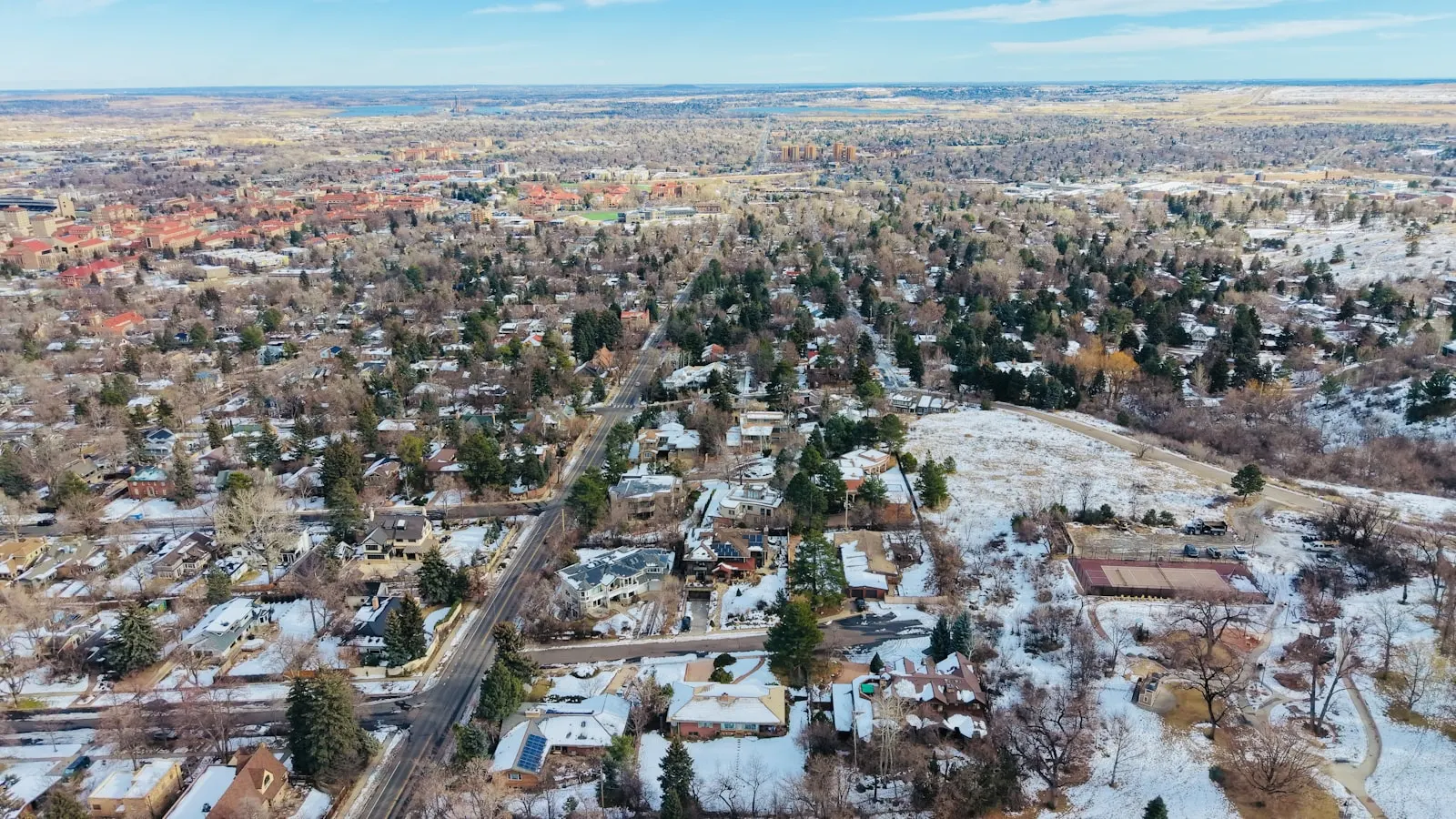
Elevation gets the credit, and the credit is misplaced. Parker sits at 5,869 feet, but the blocks that freeze first aren't the high ones. On a clear, still night, cold air behaves exactly like water: it slides off the ridges and settles into Cherry Creek and the gulches feeding it, and a house backing the Cherry Creek Trail can sit several degrees colder at dawn than one on a Stonegate rise a hundred feet above it. First freeze historically lands in the opening days of October, and the last spring freeze holds on until roughly early May. Down on the creek bottoms, treat both of those dates as optimistic.
Which means there isn't one freeze calendar for this town. There's yours, set by where your lot sits in the drainage. If your driveway is the low point of the block and fog settles in the backyard on October mornings while the neighbors up the hill are still mowing, you're on the early schedule whether the forecast agrees with you or not.
- Bonus room over the garage: bath or wet bar lines buried in the floor
- Laundry on a shared garage wall: hot and cold in an exterior bay
- Hose bibs on north and west walls, hoses still attached in October
- Garage-ceiling runs on creek-bottom lots, sitting in pooled cold air
- If a faucet coughs and quits in a cold snapLeave it open, find the cold run, warm it back from the fixture
- If two fixtures on one wall die togetherThe ice is in the wall bay, not the fixture; call before cutting
- If flow returns but pressure feels wrongAssume a split and go hunting for a damp spot right now
What frozen pipe repair in Parker involves, and what it runs
A frozen line that hasn't split yet is a race you can still win. Open the faucet it feeds so melting ice has somewhere to push pressure. Warm the run gradually, working from the fixture back toward the cold: a hair dryer, a space heater aimed into an open cabinet, a heat lamp in the garage bay under the bonus room. Never a torch. Never heat tape left running on a line you can't watch. If nothing moves within an hour, or you can't tell where the ice actually sits, stop escalating heat and call, because plumbers carry thawing gear that locates hidden ice without anybody guessing at drywall.
Broad Front Range ranges, and access moves all of them: a professional thaw is usually a service call plus an hour or two of labor, commonly $150 to $400 when the line can be reached. Opening a wall or a bonus room floor to replace a split section commonly lands between $400 and $1,200 for the plumbing alone. The water is the expensive part. Once ceilings, insulation, and flooring get involved, restoration routinely runs into four figures, and a burst above a garage drains straight down through the rooms you'd least like to rebuild.
Material matters here because Parker spans two building eras. The 90s two-stories run mostly copper, which splits cleanly and floods fast. Newer builds run PEX, which flexes through a freeze more often than not but still fails at fittings and at any spot that's frozen before. Surviving one January proves nothing. A line that froze last winter is a marked line, and it will pick a colder night to say so. If yours does let go while you're at work, the Parker emergency guide covers which valve to close first.
Weak flow on a cold morning is the only free warning you get. Thaw it that day, then fix the exposure that caused it: insulate the bay, seal the garage air, and stop treating a bonus room as a room instead of an outdoor cabinet with carpet. Ignore it and the next hard night writes a much larger check.
Dealing with this in Parker?
Start a quoteTen dollars of foam and one October afternoon
The prevention list is short, cheap, and boring, which is exactly why it gets skipped. Pull every hose in late September, ahead of the historical first freeze rather than after it. Drain the bibs and cover them. Foam-sleeve any run you can reach in the garage ceiling or along a garage wall, and give real attention to the bay behind the washer. Then seal the gaps where the garage meets the house, especially around the band joist, because what freezes that laundry line is usually air moving through a gap, not air sitting still.
For the bonus room, add two habits. Leave the door open when the overnight low goes negative so the furnace has some reason to care about that room, and crack the vanity cabinet so warm air can reach the pipes running under the floor. On the worst nights, a pencil-thin trickle from that faucet costs a few gallons and beats the alternative by several thousand dollars. And if you leave town over the holidays, don't set the thermostat to 50 and drive away. Ask a neighbor to walk through, or shut the water off at the main and drain the lines down.
Neighbors on higher, newer ground fight a different version of this fight. The Lone Tree freeze guide deals with tighter envelopes and much less cold pooling, and the rest of our Parker plumbing guides explain why this one keeps circling back to the drainage. Cold air, like everything else in this town, ends up in the creek.
Keep exploring
More for Parker and nearby
All Parker plumbing guides Frozen Pipe Repair across the Front Range Castle Rock Lone Tree
Questions we actually get
Frozen Pipe Repair in Parker: quick answers
Which pipes freeze first in a Parker two-story?
Anything running through a floor or wall that borders the garage. Bonus room bath and wet bar lines sit in a joist cavity over unheated space, and laundry lines on a shared garage wall sit in an exterior bay. Hose bibs go early too, especially with a hose still attached holding water against the valve. Creek-bottom lots see all of it sooner.
The faucet came back on by itself. Is the pipe fine?
Not necessarily. Ice can expand a fitting or open a hairline split that only leaks once full pressure returns, and it may weep behind drywall for weeks before a stain shows. Watch the ceiling below, listen for running water when every fixture is off, and check your meter. A line that froze once will freeze again in the same spot.
Is heat tape worth running in the garage?
It can be, on a specific exposed run you can see and inspect, with a thermostat and a modern UL-listed product. It's a poor substitute for insulation and air sealing, and it's a genuine fire risk when it's old, daisy-chained, or buried under foam where nobody looks at it. Fix the cold air first, then add tape only if the run is still losing.
Cold tap in a Parker bonus room?
Tell us which fixture quit, what the night got down to, and where the run hides, and a real person will point you at the fix.
Get My Free Quote