
Freeze help on Palmer Divide time
Frozen Pipe Repair Castle Rock CO
Pipe Thawing, Burst Repair & Freeze Prevention
Castle Rock's winter opens in late September and doesn't fully let go until May. Between those dates, walkout walls, cold-pooling gulches, and empty commuter houses do most of the damage. This guide covers safe thawing, the walls builders under-insulated, and the vacation checklist that saves basements.
- Seven-month freeze window
- Walkout walls run cold
- Safe thawing, step-by-step
- Burst-pipe help routed fast
Frozen pipe repair in Castle Rock starts with geography
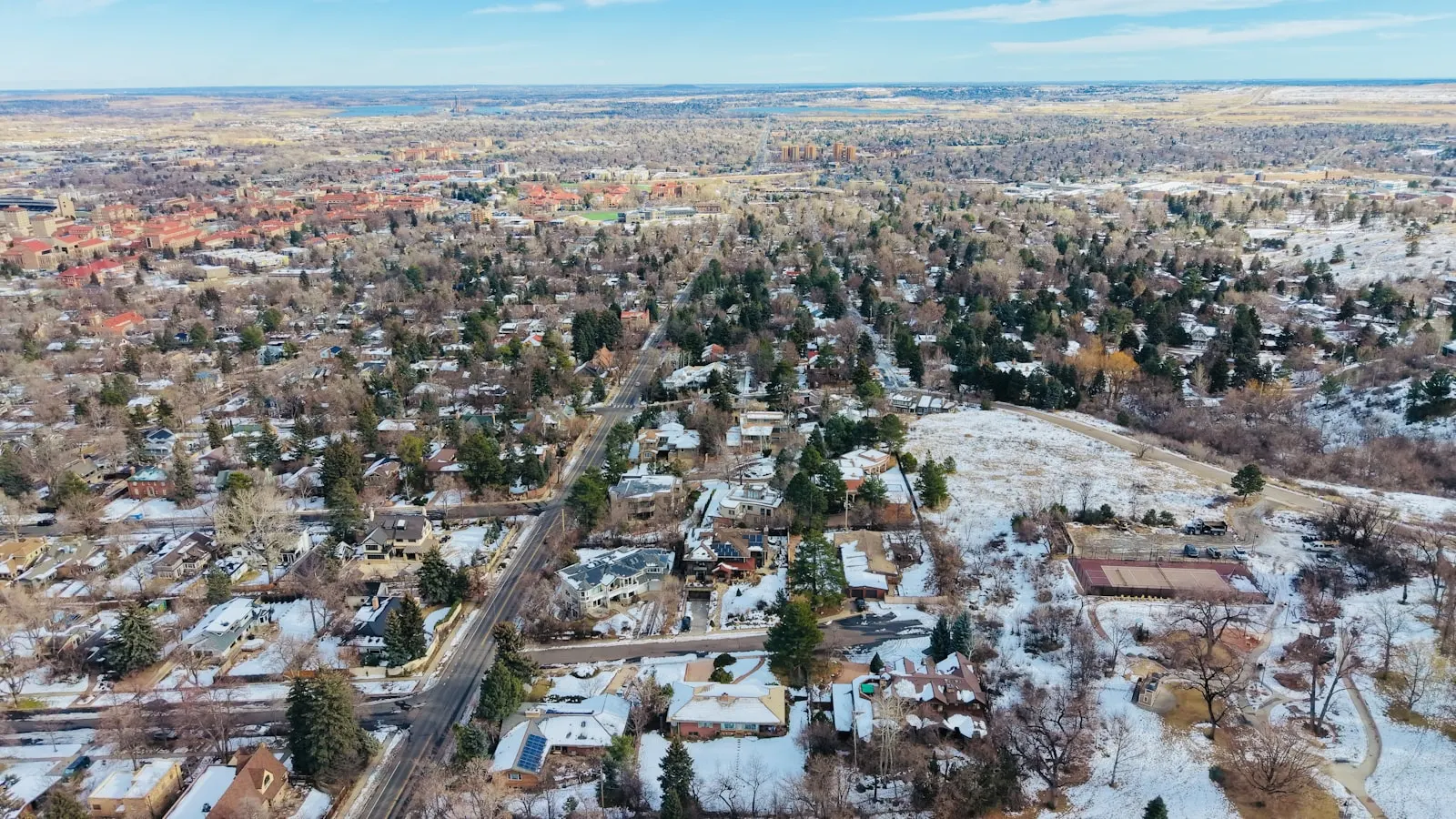
At 6,224 feet on the Palmer Divide's north slope, Castle Rock takes winter early and holds it late. The first freeze historically arrives around September 28, snow typically follows near October 8, and the last spring freeze hangs on until about May 10. Storms riding the Divide hit this town before they slide down into the south metro, and on calm, clear nights, dense cold air pools in the draws and gulches the town is folded into.
That cold pooling is why two neighbors can compare freeze stories and not believe each other. A house down along a drainage can sit several degrees colder overnight than one up on a shoulder, with no forecast mentioning either. If your street feels like the cold spot, believe it. Your pipes already do. Wind is the other multiplier: gusts pouring off the Divide strip heat from an exposed wall far faster than still air at the same temperature, which is why some lines fail on breezy nights that never touch zero.
The practical read: your winterization calendar runs two or three weeks ahead of a friend's in central Denver, and your margin for the forgotten hose or the uninsulated bib stays thinner than theirs all season long.
Builders hid pipes where winter looks for them
The signature Castle Rock freeze risk is the walkout basement. South-facing walkouts backing to open space are the premium lot, and builders loved putting a wet bar or a bathroom against that rear wall, which is framed like an above-grade wall and takes wind straight off the Divide. Sun bakes it all afternoon. Then the temperature falls off a cliff at dusk and the plumbing sits in a cooling cavity until sunrise. Crystal Valley and the newer Meadows filings are full of this exact floor plan, and the wet bar wall is almost always the coldest plumbing in the house.
Most of these weak points stay invisible until the one hard week that matters. A finished basement hides the pipe path, the framing hides the insulation gaps, and the only early clue is a fixture that runs slow and reluctant on the coldest mornings. Take that clue seriously the first time it appears. The rest of the risk list is familiar production-build territory:
- Wet bar and bath lines in walkout rear walls
- Supply runs through cantilevered bump-outs and garage ceilings
- Hose bibs that aren't frost-free, or froze with hoses attached
- Mechanical rooms with vents leaking cold air across pipes
Thawing without making it worse, and the cost reality
A frozen pipe that hasn't burst is a race you can still win. Open the affected faucet so melting ice has somewhere to push pressure, then warm the line gradually: a hair dryer, a space heater aimed into the open cabinet, heat working backward from the faucet toward the freeze. No torches, ever. No heat tape left running unattended on a line you can't see. If nothing flows within an hour, or you can't find the frozen stretch at all, that's the moment to call a pro rather than escalate the heat. Plumbers carry thawing equipment that finds and warms hidden ice without opening walls on a hunch.
Professional thawing is usually a modest visit, commonly a service call plus an hour or two of labor. A burst is a different animal entirely: water damage stacked on repair, often four figures once drywall and flooring join the bill. And PEX, the workhorse of Castle Rock's housing stock, tolerates a freeze better than copper but still splits at fittings and repeated freeze points. Surviving one freeze isn't a warranty. It's a warning shot with a return address.
One local wrinkle: on a slab-on-grade plan, a freeze-split line can present as a slab leak, warm floor and all, weeks after the cold snap that caused it. If flow dropped during a January freeze and a mystery leak surfaced in February, tell the plumber both facts. It shortens the hunt considerably.
The gap between a frozen pipe and a burst pipe is usually one more cold night. Thaw gently the same day you notice weak flow, fix the exposure that caused it, and treat any line that's frozen twice as a marked line. It will find its third time in January.
Dealing with this in Castle Rock?
Start a quoteThe vacation freeze, this town's signature loss
Castle Rock households travel: ski weekends up the hill, holidays back wherever home used to be, work trips out of DIA. The empty-house freeze does more damage here than any single storm, because a furnace hiccup during a week away turns a small mechanical fault into a flooded main floor with nobody home to hear the first drip. Drive any street near Philip S. Miller Park in mid-January and count the driveways that stay snowed-in for a week straight. Every one of those houses is running an unattended experiment in mechanical reliability.
The before-you-go list is short and worth ritualizing. Hold the heat at a sensible temperature instead of a deep setback, and open interior doors and vanity cabinets so warm air reaches plumbing walls. Better still, close the main shutoff and open a faucet to drain pressure, which caps the worst case at a wet stretch of pipe instead of a ruined floor. A neighbor walking through midweek beats any gadget, and a couple of inexpensive leak sensors, one under the water heater and one under a sink, will text you before the ceiling knows anything.
If you do come home to a burst, close the main and go straight to our emergency steps for Castle Rock. And if you're weighing freeze exposure around the Divide, Monument's frozen pipe page shows what another thousand feet of elevation does to this whole calendar.
Keep exploring
More for Castle Rock and nearby
All Castle Rock plumbing guides Frozen Pipe Repair across the Front Range Parker Lone Tree
Questions we actually get
Frozen Pipe Repair in Castle Rock: quick answers
At what temperature do Castle Rock pipes actually freeze?
There's no single number, because exposure matters more than air temperature. Pipes in heated interior walls shrug off nights that burst lines in walkout walls and cantilevers. As a working rule, single digits overnight put poorly insulated runs at risk, and consecutive nights below zero, which the Palmer Divide delivers most winters, find every shortcut a framing crew ever took.
My pipes froze but didn't burst. Did I dodge it for good?
You dodged it once. Freezing stresses pipe and fittings, and PEX that survived may have pushed a fitting to its limit, while copper work-hardens at the freeze point. More to the point, whatever exposure froze that line still exists. Fix the insulation gap or air leak now, in daylight, or plan on meeting the same freeze during the next stretch of hard cold.
What should the thermostat hold at when we travel?
A moderate hold beats a deep setback: many plumbers suggest somewhere around the mid-50s or warmer, because plumbing walls need margin above freezing when overnight temps go negative. But the thermostat is only the backup plan. Closing the main shutoff and draining pressure before you leave is what actually caps the damage if the furnace fails while you're gone.
Frozen line under the Divide?
Describe where the flow stopped and we'll route your Castle Rock request to someone who can thaw it right.
Get My Free Quote