
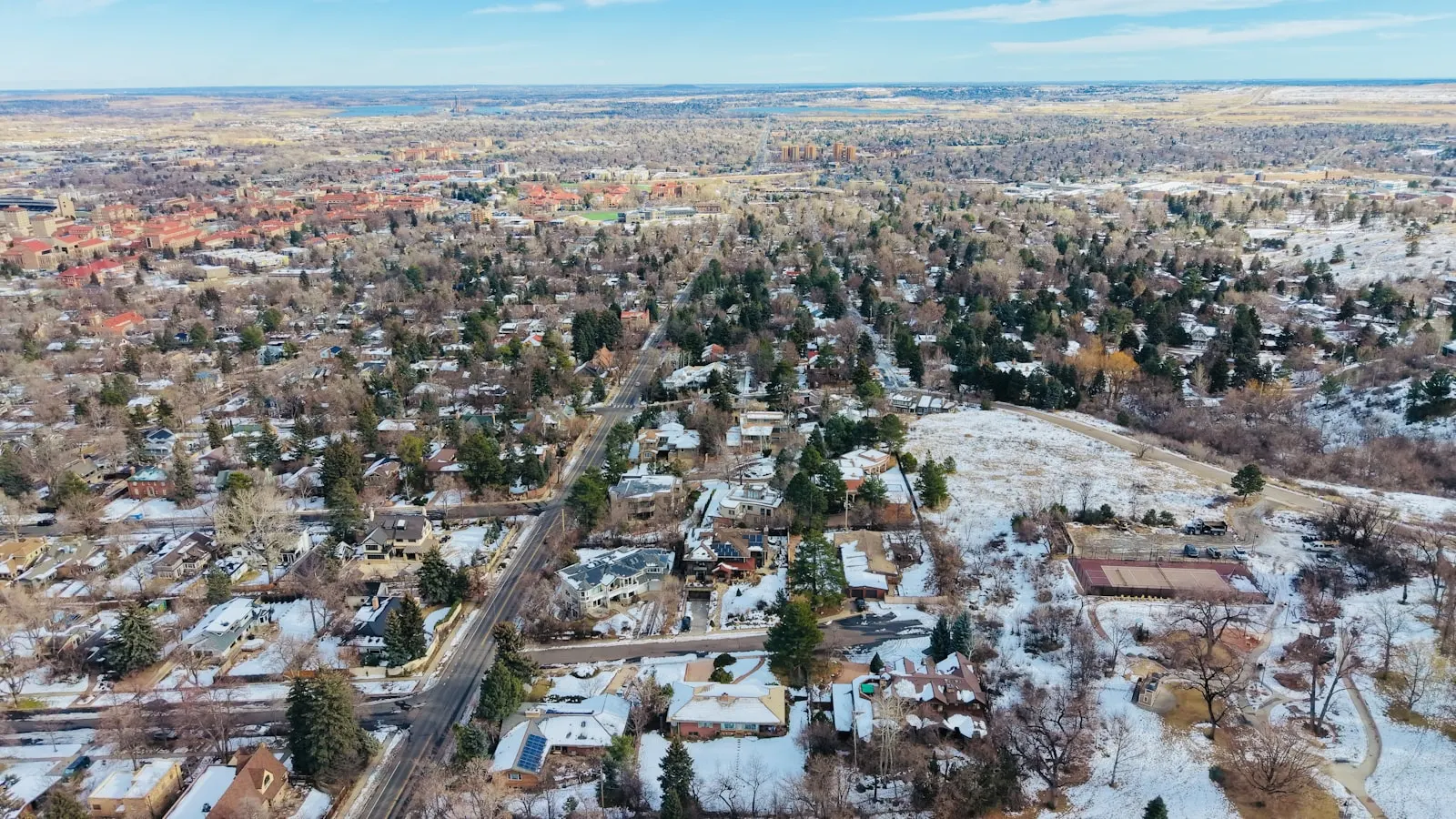
Freeze guidance for Arvada, Colorado
Frozen Pipe Repair Arvada CO
Pipe Thawing, Burst Repair & Freeze Prevention
Cold air behaves like water: it flows downhill and pools in low spots. On still January nights it slides off the hogback and settles along Ralston Creek, while Candelas up top takes the wind instead. Arvada freezes twice, in two different ways. Your pipes should know which winter they live in.
- Two freeze patterns, mapped
- Stone foundation weak points
- Safe thawing that works
- Fast help when it bursts
One city, two ways to freeze
Frozen pipe repair in Arvada starts with a map, not a heat gun. Up at Candelas and Leyden Rock, past 5,600 feet, the enemy is wind: downslope gusts strip heat from walls and find every hose bib, garage line, and under-insulated corner facing the hogback. The air doesn't have to be that cold when it's moving that fast. West-siders learn this their first January, usually from a neighbor's story, occasionally from their own ceiling. Wind chill doesn't officially apply to pipes, but moving air strips warmth from a wall cavity far faster than any calm night could, and the hogback keeps the air moving.
Down in the old core the enemy is stillness. On calm, clear nights, cold air drains off the high ground and pools in the Ralston Creek bottom, so the creek-side blocks can sit meaningfully colder than houses a short walk uphill. Pair that pooled cold with Olde Town's stone and brick foundations, which shrug off weather but hold no warmth, and pipes running along century-old rim joists spend all winter closer to the edge than anyone upstairs realizes. Historically the first freeze lands around October 3 and the last hangs on to early May. That's a long season of nights to get through.
Where each era of house is weakest
In the pre-war blocks, the freeze rarely hits the original house first. It hits the additions: the kitchen or bath somebody hung off the back of a Victorian mid-century, over a shallow crawl space, with plumbing run along the outside wall because that's where the sink wanted to be. Rubble stone foundations breathe cold air straight onto those runs. If your old house has one chronically cold room with water in it, you've found your weak point without a thermometer.
The ranch belts freeze at their edges: laundry lines through unheated garages, hose bibs installed before frost-free sillcocks were standard, and the odd pipe in an exterior wall that a 1970 framer thought nothing of. Candelas fails at its punch list, where a missed insulation batt behind a wind-facing bib does fine for two mild winters and then meets a real one. Different houses, same physics. Water sitting still, in pipe, next to cold, loses every long game it plays.
Thawing a line without starting a fire, and when to stop
If a faucet goes dead on a cold morning, move deliberately. Open the affected tap so melting ice has somewhere to push, find the coldest accessible run between the meter and that fixture, and warm it gently from the faucet side backward: a hair dryer, a heat lamp at a respectful distance, warm towels swapped patiently. Frost on the pipe's outside often marks the plug. What never belongs near a frozen pipe is flame, and in balloon-framed Olde Town walls stuffed with a century of dry framing, a heat gun run carelessly is nearly as bad.
Know when to hand it off. Pipe you can't reach, ice you can't locate, or a freeze inside a finished wall is professional territory, and along the Front Range a thawing call commonly lands between $200 and $600 when nothing has split. If water appears anywhere it shouldn't, the job has changed: get the main closed, because a thawing burst goes from damp to destructive in minutes. The emergency guide covers those first five minutes in detail. Stage towels and a bucket before you start thawing, not after.
The judgment call on repairs is about the pipe's future, not its past. A split copper section in an accessible ceiling is a modest fix. The same split in that back-addition crawl space is an invitation to reroute the line somewhere warmer while the wall is already open, and the reroute is usually the smarter dollar. Ask any plumber quoting a freeze repair one question: what stops this exact pipe from freezing again in February?
Thaw gently from the open faucet backward, never with flame, and quit the moment you find water where it shouldn't be. Budget a few hundred dollars for a professional thaw and be glad when that's all it is. And treat every freeze as a diagnosis: the pipe told you exactly where the house is weak. Fix the weakness, not just the split.
Dealing with this in Arvada?
Start a quoteThe calendar that keeps you off this page
Arvada's freeze dates write the schedule for you. First freeze historically arrives around October 3, so hoses come off and sprinklers get blown out in late September up west, early October at the latest in the flats. Last freeze holds until about May 5, which is why the creek-side gardeners who charge their sprinklers in mid-April sometimes pay for the enthusiasm. In between: crawl space vents closed by November, cabinet doors open on single-digit nights, and a trickle left running at the most freeze-prone faucet when the forecast turns ugly. None of it costs much. All of it beats meeting this page's third section in person.
Leaving town in winter deserves its own ritual. Heat stays at 55 or better, someone checks the house every few days, and if nobody can, shut the main and open the taps before you go, because an unwatched house and a cold snap is the worst combination this page knows. A leak sensor with a phone alert under the most freeze-prone run costs little enough now that winter travelers here have small excuse to skip it. Your neighbors uphill in Westminster face the same early freeze with much of the same housing, and their guide is worth a read if you're comparing habits. The rest of your house's winter story lives in the Arvada plumbing guide.
Keep exploring
More for Arvada and nearby
All Arvada plumbing guides Frozen Pipe Repair across the Front Range Westminster Wheat Ridge
Questions we actually get
Frozen Pipe Repair in Arvada: quick answers
How cold does it have to get before Arvada pipes freeze?
There's no single number, because exposure decides. A sheltered interior line can ride out a subzero night untouched while a wind-facing Candelas hose bib gives up in the low twenties. Risk climbs sharply once nights sit in the teens, and wind or a creek-bottom cold pool moves that threshold higher. Watch sustained cold plus wind, not just the headline low.
Why does the creek side of the street freeze harder?
Cold air drains downhill like water and pools in low ground, and the Ralston Creek bottom is Arvada's collection basin on still, clear nights. Houses along the creek can sit several degrees colder than homes a block uphill, which is enough to tip a marginal pipe over the edge. If you're creek-adjacent, winterize like you live somewhere colder than the forecast says. You do.
A pipe froze but never burst. Am I in the clear?
Mostly, but verify before you celebrate. Ice expands with enough force to open hairline splits that stay sealed until the plug melts, so watch the run closely as it thaws and check again under full pressure. Then treat the freeze as free information: that pipe just told you it's the coldest vulnerable point in the house, and insulating or rerouting it now is the cheap version of this story.
Frozen line at your Arvada place?
Tell us which fixture died and what kind of house it's in, and we'll route your quote while you keep the faucet open.
Get My Free Quote