
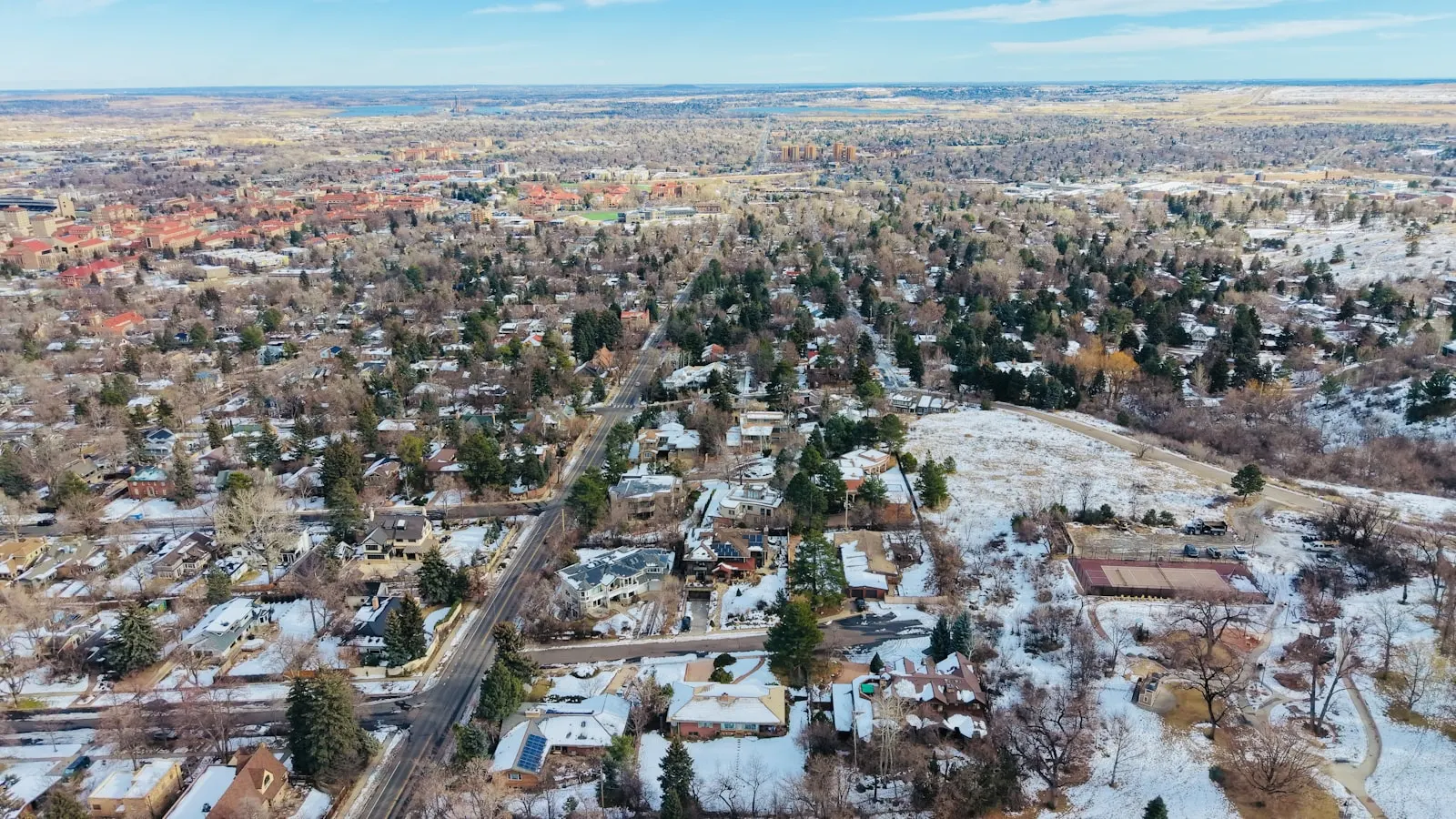
Freeze season runs October into May here
Frozen Pipe Repair Centennial CO
Pipe Thawing, Burst Repair & Freeze Prevention
The first hard freeze historically hits Centennial around October 3, and the pipe it finds first runs through an uninsulated 1960s garage wall. Add an evaporative cooler line still charged from summer and a twelve-zone sprinkler system, and early fall becomes a checklist with a hard deadline.
- Garage line weak spots mapped
- Cooler and sprinkler deadlines
- Thaw safely, without torches
- Fast answers from real people
The garage wall that freezes first
Walk into the garage of a 1968 Centennial split-level and look at the wall it shares with the house. Somewhere inside that wall, or strapped along its face, runs a water line: laundry supplies, a hose bib feed, sometimes the branch to a basement bathroom somebody added in 1984. The garage was never insulated like the living space, the door gasket gave up during the Clinton years, and when the first hard freeze arrives in early October, that wall holds the coldest plumbing in the building. Frozen pipe repair in Centennial starts here more often than anywhere else.
Split-levels add a quirk of their own: the garage-level half bath. Its supply lines often ride the rim joist above the garage door, catching every draft that sneaks past the weatherstripping. If that toilet won't refill on the first cold morning of October, you've found your house's canary. Don't shrug it off. The line that freezes and recovers in October is the same line that bursts in January, when the freeze is deeper and lasts all week.
The fixes are unglamorous and they work. Foam sleeves on every exposed run. Caulk or spray foam in the rim-joist gaps. A habit of keeping the garage door down on single-digit nights. Call it a forty-dollar Saturday, honestly, and it retires the most likely burst in the house. Best done in September, while the weather's still friendly.
Two summer systems that bite in October
Evaporative coolers earn their keep through a Centennial summer, and then October arrives and the quarter-inch supply line running up to the roof is still charged. That skinny copper or poly line freezes before anything else on the property, splits without a sound, and reveals itself as a ceiling stain during a January thaw, months after the actual crime. Shut the cooler's water down and drain the line by early October, ahead of the first freeze, not after the first snow shows up around the middle of the month. Put it on the same calendar reminder as the furnace filter, and it stops being a memory test.
Sprinklers are the bigger-ticket version of the same deadline. Lots here run big systems, many original to the house, and the blowout window is real: with freezes historically starting in the first days of October, late September is the target that leaves margin. The backflow preventer is the tender part, sitting above grade with water trapped in its body. If a hard freeze is forecast before your blowout appointment, at minimum shut the inside irrigation valve and open the backflow's test cocks to relieve it. That five-minute move has saved a lot of $300 spring repair bills.
- Late September: sprinkler blowout booked and done
- Early October: cooler line drained, hoses off every bib
- First cold snap: garage door down, check the half-bath refill
- Single-digit nights: cabinet doors open, far faucet at a trickle
Frozen pipe repair in Centennial: thaw, fix, bill
First, the difference between frozen and burst, because the response differs completely. Frozen means no water at a fixture during a cold snap and nothing wet anywhere: you have time, but not much of it. Open the affected faucet, then warm the suspect run with a hair dryer or a heat lamp, starting nearest the tap and working back. Never a torch, not near framing, not ever. Burst means water where it shouldn't be, and the main shutoff comes first before any detective work. And know that ice sometimes plugs its own crack, so a line that froze hard deserves watching while it thaws, with a hand near the valve.
On cost, along the Front Range a straightforward thaw-and-check call commonly runs a couple hundred dollars. A burst repair with a section of pipe replaced often lands between $500 and $1,500 depending on access. Once a finished ceiling or wall gets involved, drying equipment and drywall push totals into the low thousands, which is the entire argument for the forty dollars of foam insulation two sections back. Cheap prevention, expensive cure, pick one.
If it does burst, the first five minutes matter more than the next five hours, and that exact sequence lives in our emergency guide. Read it once on a dry day. It reads badly by flashlight.
- If a line froze but didn't burstthaw it slowly, then insulate that run this same week
- If the same run freezes every winterreroute it or add heat tape: the third freeze is on you
- If a pipe burst behind finished drywallshut the main now and treat it as the emergency it is
Dealing with this in Centennial?
Start a quoteA split-level winter routine that actually holds
Freeze season here is genuinely long: first freeze around October 3, last freeze hanging on to early May, seven months in which a hard cold snap is always plausible. The routine that survives that stretch is boring on purpose. Hoses off the bibs by late September. Cooler drained and sprinklers blown out by early October. Garage runs insulated once, and then never thought about again. On the truly cold nights, cabinet doors open under sinks on exterior walls, and a pencil-lead trickle at the faucet farthest from the meter if the forecast dips below zero.
Empty houses deserve extra respect between November and March. More than one Centennial family has come home from a ski week to find the ceiling on the floor and the furnace running like a swamp pump. Have someone check the house daily, or shut the main and drain down before you leave. Down in Parker, the same storms work over newer construction in different ways, and the corridor-wide checklist lives on the frozen pipe hub if you're winterizing more than one address this fall.
In Centennial, winterizing is a date problem, not a knowledge problem. The freeze arrives in the first days of October, on schedule, every year. Beat it by two weeks: hoses, cooler line, sprinkler blowout, garage insulation. Do that and the seven-month freeze season becomes something you mostly watch through the window.
Keep exploring
More for Centennial and nearby
All Centennial plumbing guides Frozen Pipe Repair across the Front Range Parker Highlands Ranch
Questions we actually get
Frozen Pipe Repair in Centennial: quick answers
At what temperature do pipes freeze in Centennial homes?
Exposed lines in unheated spaces (garages, rim joists, crawlspaces) start freezing after several hours below roughly 20 degrees, and the season's first single-digit night finds every weak point at once. Interior pipes in heated rooms rarely see risk. Around here the calendar matters as much as the thermometer: hard freezes historically begin in early October, months before it feels like winter.
Can I thaw a frozen pipe myself?
Often, if nothing has burst yet. Open the faucet the line serves, then work heat along the run from the faucet backward: hair dryer, heat lamp, warm towels. No open flame, ever, and no space heater left alone in a garage. If you can't find the frozen section, or it sits behind finished drywall, stop and get help before it thaws into a leak you can't reach.
Is late October too late for a sprinkler blowout?
It's gambling, and the backflow preventer holds the stakes. Centennial's first freeze historically lands around October 3, with first snow near mid-month, so by late October the system has likely already seen freezing nights. Book late September instead. If you miss the window, shut the inside irrigation valve and relieve the backflow until the truck arrives.
Beat the October 3 freeze.
Ask about insulation, blowout timing, or a line that just froze, and get an answer from a person who knows these houses.
Get My Free Quote