
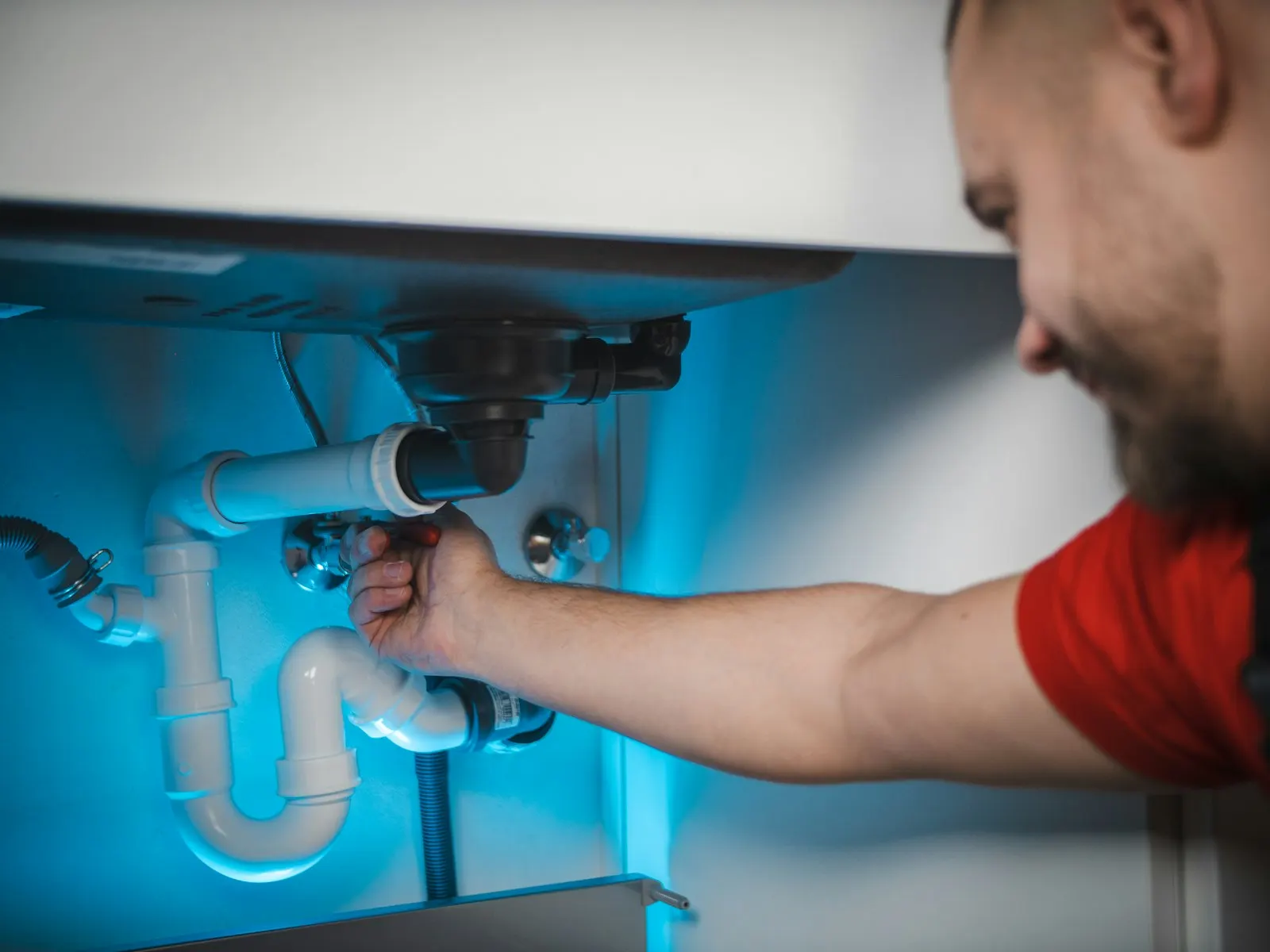
Burst pipes and bad nights in Englewood, Colorado
Emergency Plumbing Englewood CO
Burst Pipes, Active Leaks & Water Shutoff Help
In a pre-war Englewood house, a plumbing emergency comes with extra rules: shutoff valves old enough to crumble in your hand, plaster ceilings that hold water like a bowl, and lots too tight for easy access. The first five minutes decide the damage. Learn them now, not mid-flood.
- Shutoff triage, step by step
- Lath and plaster leak advice
- Old valve handling warnings
- Fast quote routing, honestly
The ceiling stain that moves
Emergency plumbing in Englewood has a signature scene, and it happens upstairs. Half the bungalow belt has an attic converted to a bedroom or a bathroom somewhere in the last eighty years, and when a supply line up there lets go, the water doesn't announce itself. It travels. Along a joist, down a lath channel, out a ceiling seam two rooms from the actual leak. You're watching a brown stain bloom and spread across plaster while the real problem hides eight feet away behind a wall that hasn't been opened since Truman.
So rule one in this housing stock: don't chase the stain, kill the water. Plaster and lath will hold gallons in a sag before letting go all at once, and every minute you spend hunting the source with the supply live is a minute the house spends drinking. Shut it down first. Diagnosis is what the calm afterward is for.
Gas deserves its own line here, too. Some of these bungalows still carry original black pipe with fittings that haven't been disturbed in generations, and a plumbing crisis is exactly when somebody bumps one. If you ever smell gas during a water emergency, that outranks everything: everyone out, no switches touched, call from the sidewalk. Water wrecks plaster. Gas ends houses. The two emergencies play by different rules, and the gas rules win every time.
Know your shutoffs before they crumble
Now the Englewood catch: the shutoff itself. The main valve in one of these houses is often a knob-era gate valve, original to the building, and a gate valve that hasn't turned since the Eisenhower administration doesn't like being asked. Force it and the stem can snap or the gate can drop half-closed forever. Old valves get turned gently, a quarter turn at a time, backing off at real resistance. Better: find and exercise yours on a calm Saturday twice a year, so the first turn of its old age isn't the one that matters.
Walk the house once and learn the map below. Ten minutes, flashlight, done. Tape a note by the electrical panel saying where the main is. Nights go better in houses where somebody did this.
While you're down there, note what kind of valve you've got. A wheel handle means an old gate valve. A lever means somebody already modernized it. If it's the wheel, put a ball valve conversion on this year's list: twenty minutes of a plumber's time on a calm day, and it changes what your worst night looks like.
- Main shutoff: usually where the service enters the cellar or crawlspace, front wall, streetside
- Meter pit: at the curb or parkway, needs a meter key, the city-side option when the house valve fails
- Water heater: cold-side valve on top of the tank, plus the gas valve beside it
- Fixture stops: under sinks and toilets, oldest ones crumble too, so turn them gently
- If water is spraying and you can reach a fixture stopclose it gently and skip the panic
- If the leak is inside a wall or ceilingkill the main, then open the lowest faucet to drain down
- If the main won't turn or breaksstop forcing it, the meter pit valve is the backup, call for help
What an emergency plumbing call in Englewood costs
Straight talk on the money. After-hours emergency service along the Front Range commonly carries a premium over daytime rates, sometimes a flat fee, sometimes a higher hourly, and a burst-pipe visit that would be a few hundred dollars at noon can run meaningfully more at 2 a.m. Ask dispatch straight out how the after-hours math works before anyone rolls. And know this: if you've already shut the water down, you've bought yourself the option of waiting for morning rates. That's what the shutoff knowledge is worth in dollars.
The work itself in this town is rarely just the pipe. It's opening lath and plaster without wrecking three feet of wall to fix three inches of copper, drying cavities that were never built to get wet, and navigating a small lot where the crew parks in the alley and hauls gear past the neighbor's fence. Expect the plumber to fix the leak and a restoration conversation to follow. Wet plaster dries slower than drywall and hides moisture longer, so cheap out on drying and you'll meet the mold later.
One honest scheduling note: not every scary symptom is a middle-of-the-night job. A drip you can catch in a pot, a running toilet, a weeping fixture stop you've managed to close: those keep until morning, at morning prices. Active water you can't stop, sewage rising, any gas smell: those are now. Ask yourself one question: is water or waste actively moving? Yes means now. No means morning, and morning is cheaper.
Dealing with this in Englewood?
Start a quoteAfter the water stops: triage for old bones
Water off, breathe. Then move like the house is wet, because it is. Open the lowest faucets to drain pressure, get furniture off wet floors, and pull baseboards where water ran along a wall so the cavity can breathe. Fans help, but patience matters more: wet lath can read dry at the surface for a week while the cavity behind it stays soaked. Resist cutting big exploratory holes in plaster yourself: a plumber with a moisture meter opens less wall than a worried homeowner with a drywall saw, and in a 1920s house every unnecessary hole is original fabric you don't get back.
And sort out what kind of emergency you actually have. A frozen line that burst is its own animal with its own prevention, covered in the frozen pipe guide. Sewage coming up the floor drain points to the lateral page, and that one's about the alley, not the attic. City line nearby? Denver's emergency guide covers the same first five minutes for the same era of housing. Different town, same old valves.
Keep exploring
More for Englewood and nearby
All Englewood plumbing guides Emergency Plumbing across the Front Range Littleton Denver
Questions we actually get
Emergency Plumbing in Englewood: quick answers
Where is the main shutoff in an old Englewood house?
Usually where the service line enters: the front cellar or crawlspace wall, facing the street, often near the floor. Some houses have it near the water heater instead. If yours is a wheel-handle gate valve, treat it gently, quarter turns, no forcing. Find it on a good day, tag it, and show everyone in the house. That knowledge outperforms any gadget you can buy.
The shutoff broke off in my hand. Now what?
Stop turning anything and don't try pliers on the stem. Your backup is the meter pit at the curb, which takes a meter key, or a plumber or the utility shutting it city-side. While help is coming, open the lowest faucets in the house to drain what's in the lines and cut the flow feeding the leak. Then have the dead valve replaced with a modern quarter-turn ball valve, this week.
Water is bulging my plaster ceiling. Should I poke it?
Only after the water is off, and then yes, carefully. Put a bucket under the lowest point of the sag and open a small hole with a screwdriver to drain it in a controlled way. It feels wrong and it's right: plaster holds surprising weight in a bowl shape, and a controlled drain beats a sudden collapse of wet lath onto the dining table.
Englewood, water winning right now?
Shut it down first, then tell us what let go and we'll route the fix fast.
Get My Free Quote