
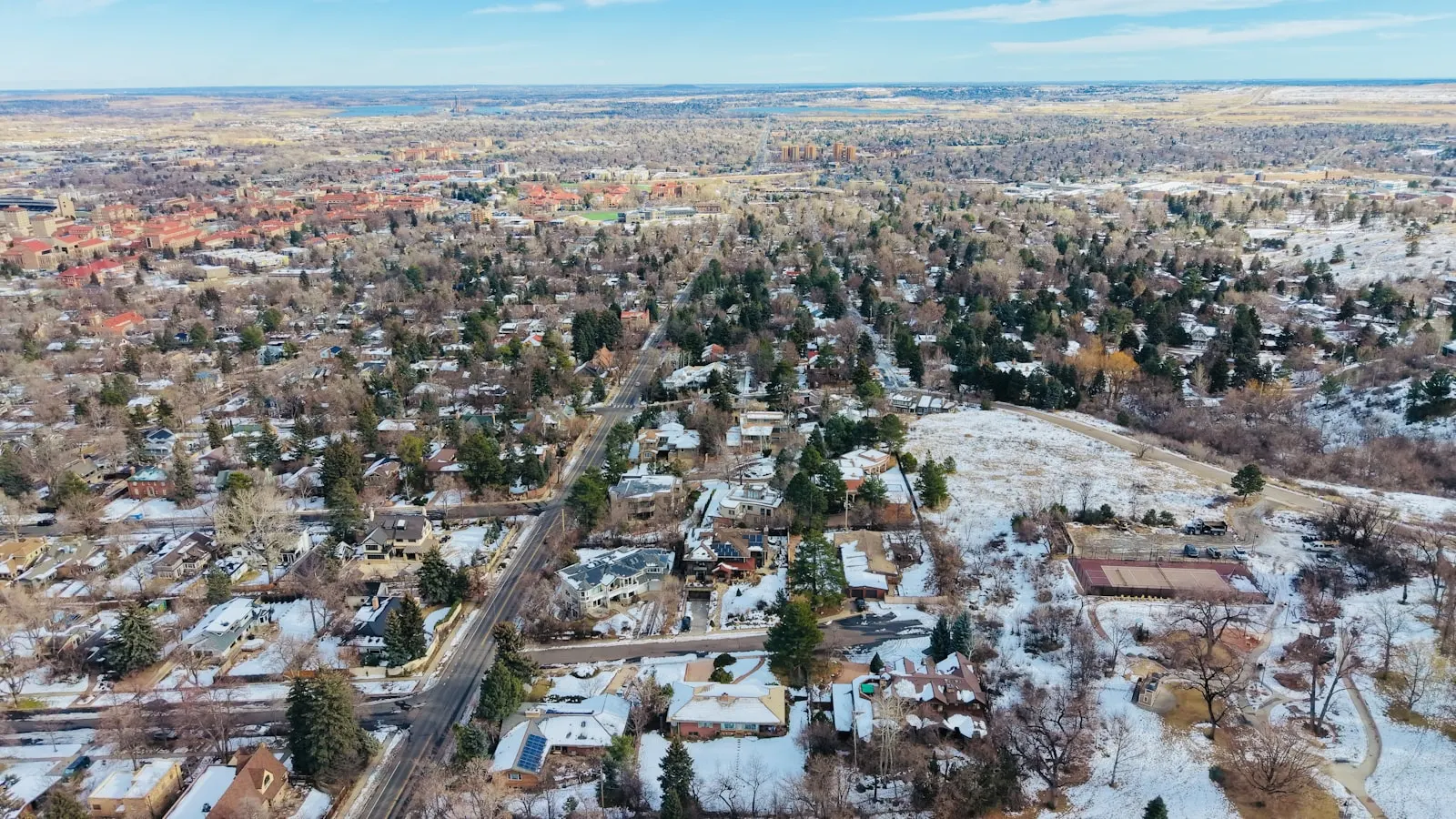
Wind fetch, bare lots, and burst season
Frozen Pipe Repair Firestone CO
Pipe Thawing, Burst Repair & Freeze Prevention
Air temperature gets the blame in Firestone, but wind does most of the damage. There's nothing between here and Wyoming to slow it down, and the trees are too young to help. A north wind puts an exposed pipe at air temperature hours faster than a still night would.
- Nothing between here and Wyoming
- Northwest walls go first
- October 1 to May 6 window
- Thaw slowly, never with flame
Wind does the freezing here, not just cold
Frozen pipe repair in Firestone follows different rules than it does in a sheltered foothills neighborhood, and the reason is fetch. Wind that crosses hundreds of miles of open plain with nothing to break it arrives here at full strength, and Firestone sits out on that ground at 4,970 feet with a subdivision skyline and not much else in the way.
The physics matter more than the wind chill number on your phone. Moving air doesn't push a pipe below the actual air temperature. What it does is strip away the thin insulating layer of still air that clings to every surface, so heat leaves the pipe far faster. A calm 18-degree night might not touch a pipe in a rim joist. The same 18 degrees with a steady north wind pulling through a gap in the sill plate gets that pipe to 18 degrees hours earlier, and hours are what decide whether it freezes solid.
That's why two Firestone houses on the same street can have completely different winters. The one with a sheltered west wall and a fence line does fine. The one whose northwest corner faces open field takes it straight on, every night, all season.
Where Firestone pipes actually freeze
The failures cluster in predictable places, and almost all of them share one trait: cold air gets to the pipe from outside the conditioned envelope. Hose bibs on north and west walls lead the list, especially when a hose was left connected and trapped water in the frost-free stem where it can't drain back.
After that come the garage-wall runs. A lot of Firestone floor plans put a laundry sink, a utility faucet, or a refrigerator line in or against an unheated garage, and garages here are cold. Rim joist runs above the garage feeding a bonus room are worse, because they sit in a joist bay that connects almost directly to outside air through the sill plate. Kitchen sinks on a north exterior wall are a classic, since the cabinet blocks house heat from reaching the supply lines behind it.
A word about PEX, because Firestone is a PEX town. PEX expands more than copper, which means it often survives a freeze that would split a copper line, and people take that as immunity. It isn't. The fittings and manifolds don't have that flexibility, and PEX still blocks completely with ice, which means no water at that fixture and pressure building somewhere it shouldn't. A frozen PEX line is still an emergency, it just fails at a different point.
- Hose bibs on north and west walls, hose still attached
- Utility and laundry lines in or along the garage
- Rim joist runs above a garage under a bonus room
- Kitchen supply behind a cabinet on a north wall
- Sprinkler backflow assemblies that never got blown out
Thawing it without turning it into a burst
If a fixture gives you nothing but a trickle on a cold morning, you probably caught it in time. Open that faucet, hot and cold both, and leave it open. An open faucet gives melting ice and expanding pressure somewhere to go, and it tells you the moment flow returns.
Then apply gentle heat, starting at the fixture and working back toward the frozen section. A hair dryer, a heat gun on low, a space heater aimed at the cabinet, warm towels wrapped around exposed pipe: all fine. Never a torch, never an open flame. Firestone framing is stick-built with plenty of insulation and vapor barrier in those bays, and house fires started while thawing pipe are a real and regular thing every winter along this corridor.
Stay in the room while it thaws. If the pipe already split, you won't know until the ice clears and water finds the crack, and at that moment somebody needs to be at the main shutoff. That's the single most common way a manageable freeze becomes a ceiling repair.
On cost, broad ranges. A thaw-and-assess call along the Front Range commonly lands in the mid hundreds, more for after-hours during a hard cold snap when everyone in Carbon Valley is calling at once. An actual burst repair depends almost entirely on access: an exposed basement run is a modest repair, while a line inside a finished exterior wall means opening drywall, repairing, and putting the wall back. Restoration after water damage is its own trade and its own invoice, and it's usually the bigger of the two.
| Where it froze | Typical access | What the fix looks like |
|---|---|---|
| Exterior hose bib | Easy, from inside the rim joist | Replace the frost-free bib, add a cover |
| Garage or laundry supply line | Usually exposed or behind panel | Thaw, repair the split, insulate and seal |
| Rim joist over the garage | Open bay from below or the room above | Repair, then air-seal the sill plate |
| Inside a north exterior wall | Drywall has to come out | Repair, reroute if possible, then patch |
Dealing with this in Firestone?
Start a quoteGetting ahead of October 1
Firestone's first freeze historically lands around October 1 and first snow tends to follow near October 16, so the freeze-prep window opens in late September, not in November when it finally feels like winter. Hoses off and drained first, because a connected hose is the top cause of split bibs out here. Then the sprinkler blowout, before mid-October rather than after the first hard night.
Foam covers on the exposed bibs are a few dollars and they work, but only if the hose is off. Insulate the rim joist above the garage and air-seal the sill plate gaps in that bay, because in a wind town, stopping the draft matters more than adding insulation on top of a leak. Heat tape has a place on specific problem runs, though only where you can see and inspect it, never buried where a fault can't be found.
Keep the garage door closed on cold nights, which sounds obvious and gets skipped constantly in houses with a workshop habit. Set a real thermostat floor when you travel, since a Firestone house that sits empty through a January cold snap has no internal heat generation at all. Open cabinet doors on north-wall kitchens and baths during the worst nights so house air can reach the supply lines.
The long game is landscaping. A windbreak on the north and west sides genuinely changes a lot's exposure, but new trees take years here and the wind isn't waiting. Build the defense into the house first. If something already let go, our Firestone emergency guide walks the shutoff sequence, the heater guide covers the appliance that hates cold garages most, and Frederick's freeze guidance reads similar because it sits on the same exposed ground.
- If a faucet trickles on a cold morningleave it open and warm the line back from the fixture
- If one wall freezes every single winterair-seal that bay in the fall, then insulate it
- If you're leaving town in Januaryset a thermostat floor and shut the main off
Keep exploring
More for Firestone and nearby
All Firestone plumbing guides Frozen Pipe Repair across the Front Range Frederick Longmont
Questions we actually get
Frozen Pipe Repair in Firestone: quick answers
Why do pipes freeze faster in Firestone than in the foothills towns?
Wind fetch. Nothing between here and Wyoming slows the air down, and Firestone's trees are too young to shelter anything. Moving air strips heat off a pipe much faster than still air at the same temperature, so an exposed line reaches freezing hours earlier than it would behind a mature windbreak. Same cold, faster clock.
My house is all PEX. Can it still freeze and burst?
Yes. PEX stretches more than copper and often survives the freeze itself, which is why people assume it's safe. The fittings and manifolds don't stretch, and a PEX line packed with ice still blocks flow completely and builds pressure. You get the same emergency, just failing at a joint instead of splitting the middle of a run.
When should I have my sprinkler system blown out?
Before mid-October is the safe target in Firestone, since first freeze historically arrives around October 1 and first snow follows near October 16. Backflow assemblies sit above ground and freeze early, and they're not cheap to replace. Book it in September, because every irrigation contractor in Carbon Valley is booked solid once the first cold night hits.
Frozen in Firestone? Start here
Tell us which fixture went dry and how cold it got last night, and we'll help you sort a thaw from a repair.
Get My Free Quote