
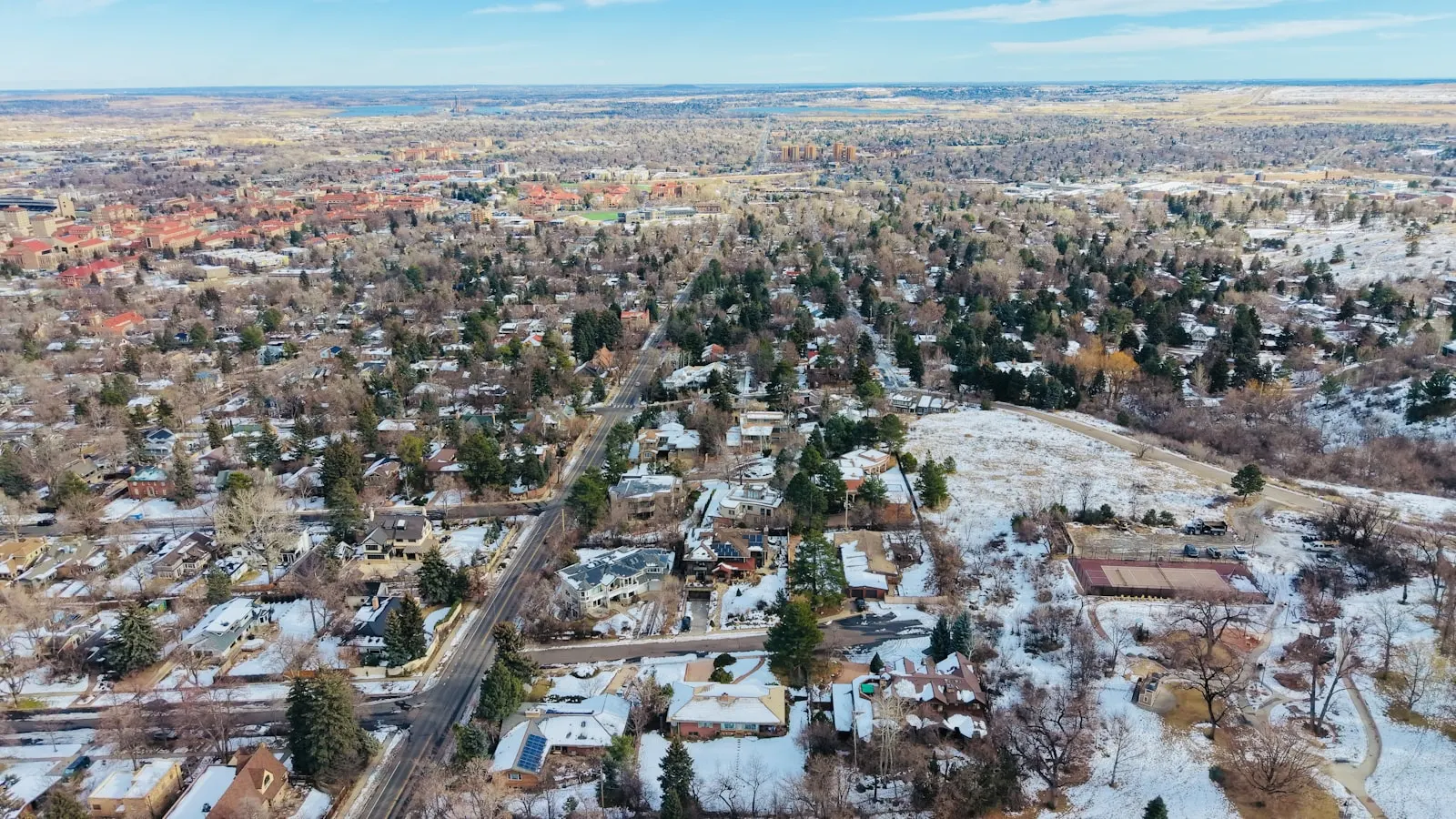
Freeze season on treed acreage
Frozen Pipe Repair Greenwood Village CO
Pipe Thawing, Burst Repair & Freeze Prevention
The first freeze historically lands around October 4, and the village's treed lots hold cold longer than the DTC concrete next door. Frozen pipe repair in Greenwood Village usually starts outside the main house: backflow assemblies, cabana lines, and hundred-foot runs to buildings nobody heats.
- Backflow assemblies freeze first
- Pool house line protection
- October 4 average first freeze
- Thaw-safe repair guidance
The backflow assembly goes first
Every estate irrigation system has one: a brass backflow assembly standing above grade, often placed prominently in a front bed where the landscape designer worked hard to disguise it with ornamental grasses. Brass, above ground, full of water, wrapped in decorative planting that blocks sunlight and traps cold air. It is the single most freeze-exposed component on the property, and it fails first nearly every year, cracking its bronze body or check valves during the season's first hard night.
The calendar is unforgiving here. First freeze historically arrives around October 4, while irrigation systems are often still running for late-season lawns, and blowout companies book solid in the last week of September. The estates that never crack an assembly winterize mid-September and accept two weeks of hand-watering. The ones that gamble on a warm October sometimes win. The springs after they lose, the repair bill includes a new assembly, a service call, and occasionally a flooded bed that took the tulips with it.
And the spring side bites too. The last freeze historically holds until around May 3, so an eager April recharge followed by one clear cold night undoes the whole winter's caution.
Ordinary hose bibs deserve a line here as well. Even frost-free models fail when a hose stays connected and traps water in the barrel, and on a property with eight or ten bibs serving beds and outbuildings, odds are one still wears its hose when October 4 arrives. Walking the grounds to disconnect them all is a fifteen-minute chore with a perfect return.
Outbuildings freeze on their own schedule
The main house is honestly the easy part. It's heated, occupied, and its plumbing mostly lives in warm walls. The freeze risk on a Greenwood Village property scales with everything else: pool houses with bar sinks and bathrooms, cabanas with outdoor showers, guest quarters kept at 50 degrees between visits, and the long shallow supply runs connecting all of it. Those runs cross open lawn where frost drives deep, and they serve buildings whose thermostats nobody checks in January.
Tree cover shifts the schedule. The mature canopy that makes these lots what they are also shades the ground, and shaded soil under the season's 48 to 60 inches of snow stays frozen longer and deeper than the sunny side of the same property. A north-facing cabana line under spruce can stay in the danger zone weeks after the driveway is bare. Whoever walks the property should know which zones thaw last, because that's where spring surprises live.
Cheap sensors have changed this game. A wifi temperature sensor in the pool house and another in the guest quarters, each set to alert below 45 degrees, costs less than dinner and stands watch all winter. Point the alerts at two phones, not one. On properties where the owner travels, that ping is often the only reason a failing cabana heater gets caught before the plumbing does.
| What freezes | When | Why |
|---|---|---|
| Irrigation backflow assembly | First hard freeze, early October | Brass above grade, exposed on all sides |
| Outbuilding hose bibs | October and November | No heated interior behind the wall |
| Pool house and cabana supply runs | Deep cold snaps, December to February | Long shallow lines, minimal heat in the building |
| North-side house lines under tree cover | Sustained subzero stretches | Shaded walls and soil hold cold longest |
Frozen pipe repair in Greenwood Village: thaw first, then decide
A frozen line that hasn't burst is a recoverable situation, and the recovery has rules. Close the valve feeding the frozen section before thawing, because ice often splits pipe invisibly and the flood arrives only when the melt does. Warm the line gradually: heat tape, a space heater in the pool house, warm towels on an exposed section. No open flame, ever, and treat heat guns near framing with the respect a torch deserves. Professional thawing commonly runs $200 to $600 along the Front Range, which is cheap against what a hidden split does when it lets go unattended.
The judgment call arrives after the thaw. Burst repair costs swing on access: a split at a cabana wall is a modest fix, while a failure along a buried hundred-foot run means locating and digging, and winter ground makes everything slower. If water is moving where it shouldn't be right now, close the nearest valve and head for our emergency page. If the line froze in a spot with a history, spend the repair visit asking why: insulation, heat tape, or rerouting turns an annual event into a solved problem.
Dealing with this in Greenwood Village?
Start a quoteA shoulder-season routine that holds
Freeze protection on acreage is a calendar, not a gadget. Mid-September: irrigation blowout booked, backflow assembly drained and wrapped. Early October: outbuilding hose bibs shut at their interior valves and drained, exterior showers emptied. Before the first deep cold: pool house and guest quarters thermostats verified at 55 degrees, cabinet doors under remote sinks left open, and the property walked once with an eye on anything wet where it shouldn't be. April: resist the recharge until the ten-day forecast shows no hard nights, remembering that May 3 is the historical last-freeze average, not a worst case.
If staff or a property manager handles the seasonal work, hand them this calendar and ask for a photo of the drained backflow assembly each fall. Trust the routine, but verify the brass.
None of this is complicated. All of it gets skipped, usually the year the owner travels in October and nobody owns the checklist. Put a name on it. The metro-wide fundamentals live at our frozen pipe hub, and Centennial's guide covers how the same freeze treats smaller lots one boundary south.
Keep exploring
More for Greenwood Village and nearby
All Greenwood Village plumbing guides Frozen Pipe Repair across the Front Range Centennial Englewood
Questions we actually get
Frozen Pipe Repair in Greenwood Village: quick answers
My pool house line froze. Can I thaw it myself?
Often yes, carefully. Close the branch valve feeding the building first, because ice can split pipe without showing it, and the leak only appears once water flows again. Then warm the space gradually with a space heater and give it hours, not minutes. Never use open flame. If the line runs underground between buildings, self-thawing isn't realistic and a professional with proper equipment is the sensible call.
When should irrigation be blown out in Greenwood Village?
Book for mid-September and treat the first week of October as a hard deadline, since the historical first freeze lands around October 4. Estate systems with many zones take longer to blow out and book earlier than small-lot service, so the calendar fills fast. The exposed backflow assembly is the component at stake; it can crack on the season's first hard night while the buried lines survive.
Do heat tape and insulation actually work on long outbuilding runs?
On accessible sections, yes, and they're worth installing during any repair visit. Heat tape protects exposed pipe at walls and crawl spaces, and foam insulation slows heat loss on runs through unheated space. What they can't fix is a shallow buried line crossing open lawn; for those, the real protections are draining the line for winter or rerouting it deeper, and a repair crew can price both.
Solve the freeze before the thaw finds you
Tell us which building, which line, and whether it's burst or just frozen, and we'll route your Greenwood Village request to crews equipped for acreage.
Get My Free Quote