
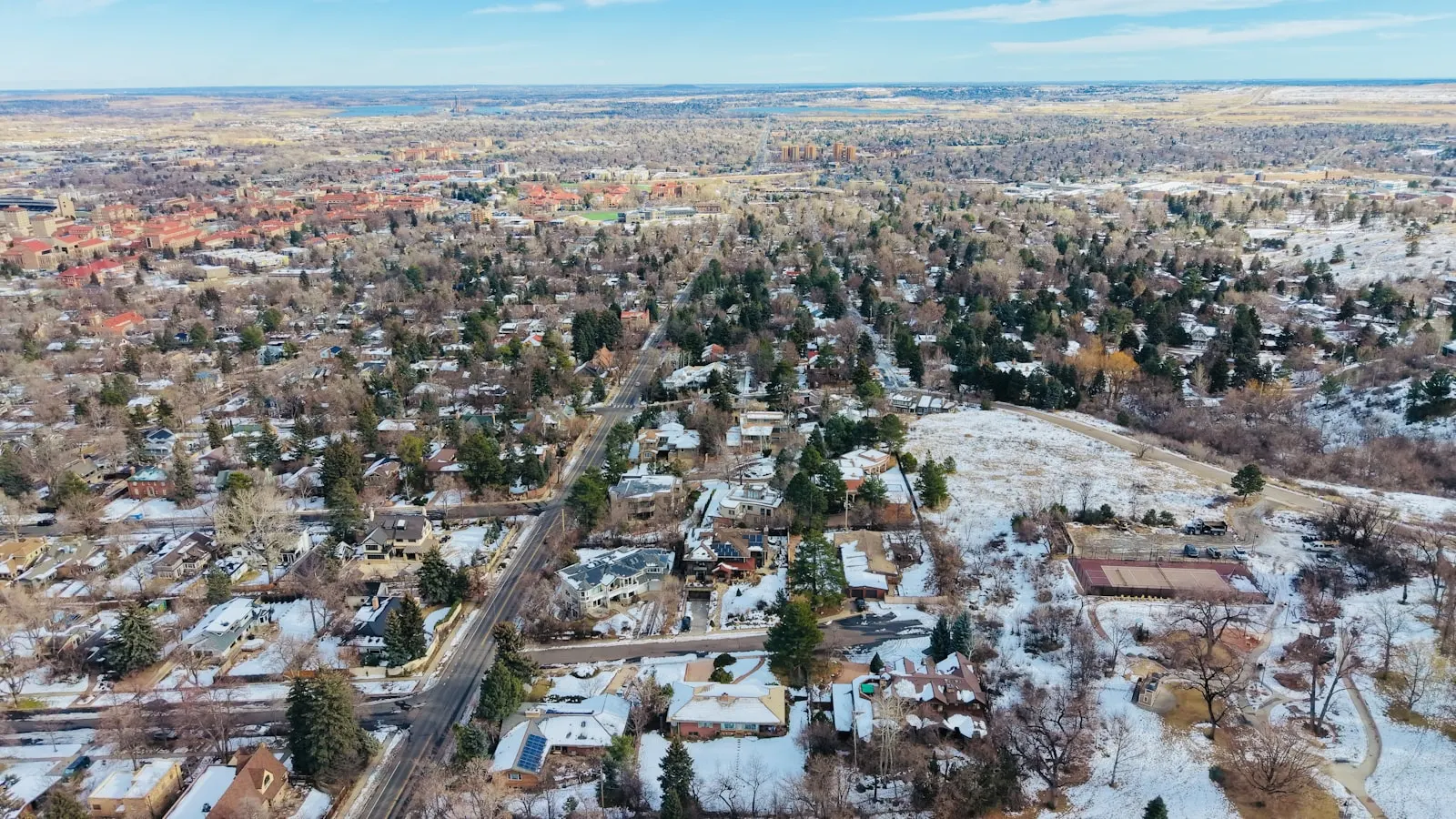
Freeze help for Lafayette, Colorado
Frozen Pipe Repair Lafayette CO
Pipe Thawing, Burst Repair & Freeze Prevention
Frozen pipe repair in Lafayette almost always leads to the same handful of places. A porch that got closed in decades ago. A crawlspace with a dirt floor. A west wall taking a downslope wind for six hours straight. Where the pipe sits matters more than how cold it got.
- Porch-addition freeze points
- Dirt-floor crawlspace risk
- Safe thawing, no torches
- October to May freeze window
Frozen pipe repair in Lafayette starts at the back porch
Every cottage in Old Town has had the same idea at some point. The back porch is covered anyway, so close it in, put the washer out there, run the kitchen into it. Good idea, and also the single most reliable place in town to find a frozen line, because a porch floor was built to shed water and let air move under it, not to hold heat.
So you get a supply line running through a bay with open air beneath it, insulation that was added later if at all, and a west or north exposure catching everything the plains send. In a normal January it's fine. On the night the downslope wind comes off the Flatirons and the temperature drops fifteen degrees in two hours, it's the first thing in the house to go.
Crawlspaces with dirt floors are the close second, for a related reason: ground moisture, a poorly sealed rim, and vents that somebody stopped closing in the fall a decade ago. That pipe isn't sitting in cold air because the weather is extreme. It's sitting in cold air because the space was never meant to be conditioned at all.
Newer houses freeze too, just differently. Out in the subdivisions it's usually a hose bib nobody drained, a garage-wall run, or a line in a west-facing exterior wall where the wind does the work for free.
Where the cold collects in this town
Lafayette sits at 5,236 feet on open plains with the Flatirons on the western horizon, and that geography does two things to freezing. The first is wind. Downslope events arrive with about ten miles of warning and then strip heat off west-facing walls for hours at a stretch. Wind chill doesn't apply to pipe the way it applies to skin, but a wall losing heat that fast absolutely does.
The second is cold pooling. Low ground holds cold air after the rest of town has warmed, and the ground near Waneka Lake and along the Coal Creek drainage runs colder on a still night than the higher blocks do. If your house sits low and your crawlspace is vented, you're on a different schedule than a neighbor three streets up.
Historically the first freeze here lands near October 3 and the last one hangs on until about May 5. That's a long window. Snow runs roughly 45 to 60 inches in a typical year, but snow isn't what freezes pipe. Clear, still, wind-scoured cold is.
| Location | Why it freezes | Fix or prevention |
|---|---|---|
| Enclosed porch additions | Open air below, added insulation at best | Insulate the bay, seal the rim, reroute if you can |
| Dirt-floor crawlspaces | Vents left open, no ground vapor barrier | Close vents in fall, lay a barrier, sleeve the pipe |
| West exterior walls | Downslope wind pulls heat straight through | Open cabinets, insulate the cavity during any remodel |
| Hose bibs and garage runs | Hose left connected past October | Disconnect, drain, consider a frost-proof bib |
Thawing without turning a freeze into a flood
First rule, and it's the one people break. Open the faucet that the frozen line feeds before you apply any heat at all. A pipe thawing with both ends closed builds pressure, and the ice plug is not always what fails. An open tap gives the melt somewhere to go, and it tells you the moment flow comes back.
Second rule: no open flame. Not a torch, not a propane heater aimed into a joist bay, not a heat gun held in one spot. Old cottages have dry framing, original lath, and sometimes knob-and-tube remnants in the same cavity as the pipe. House fires during cold snaps are usually thawing attempts. A hair dryer worked slowly along the run, heat tape rated for the job, or a space heater warming the whole space is the version that doesn't burn your house down.
Third: know your shutoff is reachable before you start, because if the pipe already split you find out the second it thaws. On cost, a plumber thawing an accessible line is often a modest visit, higher after hours. A burst line inside a wall or under a porch addition is a completely different bill, because the pipe repair is the small part and opening and closing the structure is the big part. Along the Front Range that gap is easily an order of magnitude.
Judgment call: if you can reach the pipe and see that it's intact, thaw it yourself, slowly. If the frozen run is inside a wall or you don't know where it is, call. And if water is already showing, this is an emergency, not a thawing project.
- If you can see and reach the pipeOpen the tap, warm it slowly, watch for flow.
- If the frozen run is inside a wallWarm the room, not the wall. Then call.
- If flow returns and water appearsShut the main immediately. The pipe split.
- If it freezes in the same spot twiceStop treating the symptom. That bay needs insulation.
Dealing with this in Lafayette?
Start a quoteGetting a cottage through to May
The prevention list for an Old Town house isn't long, but it is specific. Close crawlspace vents in October and open them in spring. Lay a vapor barrier over bare dirt if there isn't one, because damp ground under a crawlspace steals heat and rots framing at the same time. Sleeve any pipe running through an unconditioned bay, and pay extra attention to runs closest to an exterior wall.
Hoses off and bibs drained before the first hard freeze, which historically shows up in the first week of October and does not send a warmup ahead of it as a courtesy. If you have a frost-proof bib, it still fails when a hose is left attached, because the hose keeps water sitting in the barrel past the frost line.
During a wind event, open cabinet doors under sinks on west and north walls, and let a vulnerable faucet run a thin stream. Moving water is much harder to freeze than still water, and the small water bill is the cheapest insurance on the market. If the power goes out, treat it as urgent rather than annoying.
And if you're already opening a wall or a floor for something else, insulate while it's open. A lot of the freeze trouble we hear about in this town happens in bays that were exposed during a remodel and then closed back up empty. Louisville works with the same vintage of housing, so their freeze page reads similar, and the broader picture sits on our frozen pipe hub.
Keep exploring
More for Lafayette and nearby
All Lafayette plumbing guides Frozen Pipe Repair across the Front Range Erie Louisville
Questions we actually get
Frozen Pipe Repair in Lafayette: quick answers
How cold does it have to get before pipes freeze here?
There's no single number, because exposure matters more than the thermometer. A well-insulated interior line is fine well below zero. A supply line under an enclosed porch with open air beneath it can freeze around twenty degrees if the wind is working on it. Twenty and falling with a wind advisory posted is when Lafayette phones start ringing.
Should I leave a faucet dripping all winter?
No, just on the nights that earn it: hard freezes, wind events, and any night the power is out. Pick the faucet farthest from where water enters the house, or the one on the run you already know is vulnerable, and give it a thin steady stream rather than a slow drip. It's a targeted move, not a season-long habit.
My pipe froze but didn't burst. Am I fine?
You're fine today, and you've been told something useful. A pipe that froze once in a specific spot will freeze there again, because the reason was the space and not the weather. Before next October, get insulation, a sealed rim, or a reroute into that bay. Ice expands about nine percent, and the second or third freeze is often the one that splits it.
Frozen line in a Lafayette cottage?
Tell us where it froze and whether water's showing, and we'll get you to plumbers who know these crawlspaces.
Get My Free Quote