
Freeze guidance for Louisville, Colorado
Frozen Pipe Repair Louisville CO
Pipe Thawing, Burst Repair & Freeze Prevention
Pipes here freeze on nights that don't look cold enough to matter. At 5,335 feet, lined up with the gap that funnels wind off the Flatirons, moving air pulls heat out of a crawlspace faster than a calm sub-zero night ever will. The wind forecast tells you more than the temperature does.
- Wind matters more than degrees
- Crawlspace and rim joist risks
- First winter in a rebuild
- Thaw without splitting the pipe
The thermometer is not the number that matters
Ask around town and you'll hear the same story with different addresses. It was 22 degrees, which is nothing for Colorado, and the kitchen faucet on the north wall gave up anyway. That's frozen pipe repair in Louisville in a sentence: the failures cluster on windy nights, not on the coldest ones.
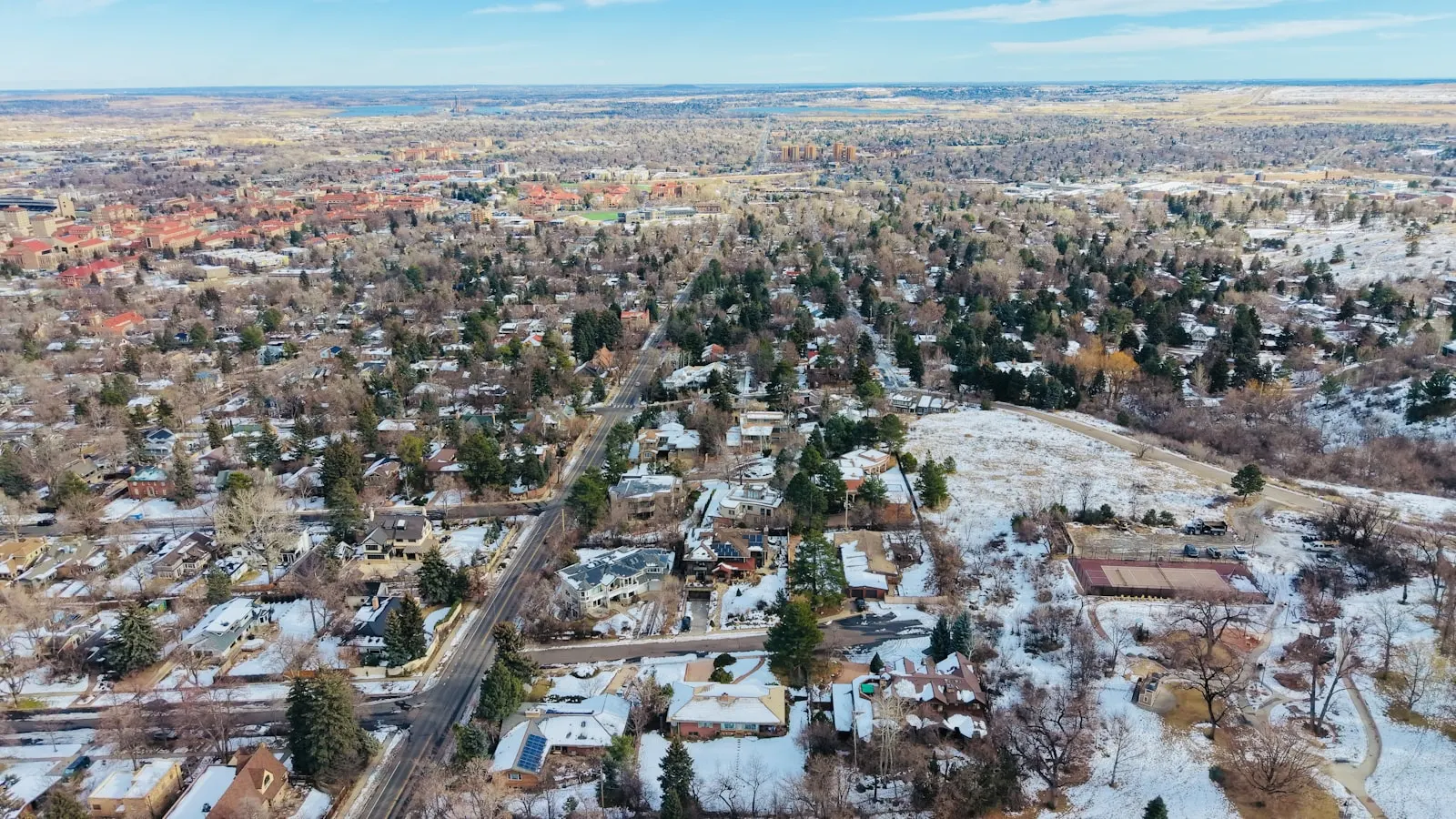
The physics are ordinary. Still air acts as a thin blanket around a pipe. Moving air strips that blanket off and keeps stripping, so a crawlspace vent facing the wrong direction on a windy night pulls heat out of a supply line for hours without stopping. Louisville sits on the last bench before the foothills, right in the path of the downslope wind that funnels through the Marshall gap, which is why a 22 degree windy night here does damage that a calm 10 degree night somewhere else wouldn't.
The calendar is long, too. The first freeze historically arrives around October 3, and the last one hangs on until roughly May 5. That's seven months of exposure, with the true danger window running from the first hard wind in November through late February.
West and northwest walls take the worst of it. If you only insulate one part of your house this fall, start there.
Cold spots by house vintage
Where a pipe freezes depends on where the house lets the wind reach it, and the answer differs sharply between the cottages and the rebuilds.
In pre-1940 homes it's almost always the crawlspace or an original kitchen line running through an exterior wall that was never insulated to any modern standard. Those crawlspaces have vents, and the vents were designed for summer moisture rather than January wind. A rigid foam block cut to fit each vent, put in during October and pulled in April, prevents more freeze calls than any other single thing a cottage owner can do.
If this is your first or second winter in a house rebuilt after 2021, the systems are new but the exposures aren't. Wind still hits the same walls it always hit. What's different is that you haven't learned yet where this particular house runs cold, and there's no previous owner's set of habits to inherit. Walk it on the first hard wind night. Touch the exterior walls, check the attached garage, look at the mechanical space, and notice which rooms lag the thermostat.
Attached garages deserve a specific mention, because they're standard in newer construction and rare in the old cottages. A laundry line or a hose bib running through a garage wall is exposed to whatever temperature that garage holds, and a garage door left open for twenty minutes on a windy evening drops it fast.
- If one fixture has no water and the rest dothen it's a localized freeze, so open that faucet and warm the run toward it
- If nothing works anywhere in the housethen suspect the main or the meter area, and shut the water off before anything thaws
- If you hear water running after a thaw beginsthen the pipe already split, so close the main immediately and call
What frozen pipe repair in Louisville involves, and what it costs
Thawing comes first, and how you thaw decides whether the bill is an hour of labor or a wall repair. Open the affected faucet so melting water has somewhere to go and pressure has somewhere to escape. Apply gentle, steady heat starting at the fixture and working back toward the frozen section: a hair dryer, a heat gun on low, a space heater aimed at the wall cavity, or towels soaked in hot water wrapped around exposed pipe. Never a torch. Open flame in a wall cavity is how a freeze call turns into a fire call, and it can boil water inside a closed section of pipe and split it outright.
A thaw with no burst is usually a modest bill: a service call, some time, and a conversation about insulating that run before next winter. Along the Front Range that commonly sits in the low-to-mid hundreds, more if access means opening drywall.
A burst is a different budget. The repair itself is often straightforward, since a plumber cuts out the split section and splices in new pipe, and that piece frequently runs a few hundred dollars for accessible pipe. What runs into real money is the water damage: drying equipment, replaced drywall and insulation, flooring, and whatever was stored below. Which is why closing the main fast matters more than any repair decision you'll make that day.
One thing that helps in a rebuilt house: if a first-winter freeze exposes something that looks like a missed insulation detail or a run in the wrong place, document it and check whether the builder's warranty still covers you. Photographs, dates, and the location in the house. That's a conversation worth having before you pay out of pocket.
| Where it usually starts | Cottage-era homes | Rebuild-era homes |
|---|---|---|
| Exterior hose bibs | Older non-frost-free bibs on west walls | Frost-free bibs that still fail if a hose is left attached |
| Crawlspace and rim joist | Vented crawlspaces with tired insulation | Sealed and insulated, though the access door matters |
| Kitchen line in an outside wall | Common, and often not insulated at all | Rare, but check bump-outs and bay windows |
| Attached garage runs | Uncommon, garages are often detached | Common, with laundry and bib lines in garage walls |
Dealing with this in Louisville?
Start a quoteA freeze calendar for this town
Late September is when the outdoor work should happen. Hoses off and drained, bibs covered, sprinkler system blown out by someone who knows the zone layout. Doing it before the first week of October puts you ahead of the historical first freeze instead of chasing it.
October and November are for the building envelope. Block the crawlspace vents, check the weather stripping on the garage door, insulate any pipe you can physically reach in an unconditioned space, and find out whether the previous owner left heat tape somewhere that needs testing. Foam sleeves cost a few dollars a length and they work.
December through February is wind-watching season. When a downslope event is forecast, open the cabinet doors under sinks on exterior walls, keep the garage closed, and let a faucet on the coldest wall run a pencil-thin stream overnight. If the power goes out and stays out, that drip matters more, not less. And if things go wrong at 11 p.m., the Louisville emergency steps start with the main shutoff.
March and April are the trap months. Warm afternoons make people reconnect hoses and charge sprinkler lines, and then a wind-driven cold front comes through and freezes the whole works. Hold the line until the first week of May. For how freeze timing shifts across the metro, the Front Range freeze guide compares towns, and the Louisville overview puts this in context with everything else that goes wrong here.
Late September: hoses off, bibs drained, sprinklers blown out. The first freeze historically shows up around October 3, so don't wait for it to prompt you. From November through February, watch the wind forecast harder than the temperature. And keep treating March and April as winter, because the last freeze here historically holds until about May 5.
Keep exploring
More for Louisville and nearby
All Louisville plumbing guides Frozen Pipe Repair across the Front Range Lafayette Superior
Questions we actually get
Frozen Pipe Repair in Louisville: quick answers
At what temperature do pipes actually freeze in Louisville?
There's no single number, because wind changes the answer. Exposed pipe in a vented crawlspace can freeze in the low twenties on a windy night, while the same pipe rides out a calm night in the teens without trouble. Treat any forecast under 25 degrees with wind as a freeze night and take the ten minutes of precautions.
Can I thaw a frozen pipe myself?
Often, yes, if you can reach it and you go slowly. Open the faucet, then apply gentle heat working from the fixture back toward the frozen area with a hair dryer or a space heater. Never use a torch. If the pipe is inside a finished wall, or if water starts running once it opens, shut the main and call someone.
This is our first winter in a rebuilt house. What should we check?
Find and photograph the main shutoff, learn where the manifold is, and confirm the irrigation blowout was done properly. Then walk the house on the first windy cold night and notice which rooms and walls run cold. New construction is well insulated, but attached garages and hose bib penetrations still freeze if a hose gets left connected.
Frozen line in Louisville?
Tell us which fixtures stopped and how cold it got last night. If a pipe has already split, shut the main off first and then write us.
Get My Free Quote