
Freeze guidance for Boulder, Colorado
Frozen Pipe Repair Boulder CO
Pipe Thawing, Burst Repair & Freeze Prevention
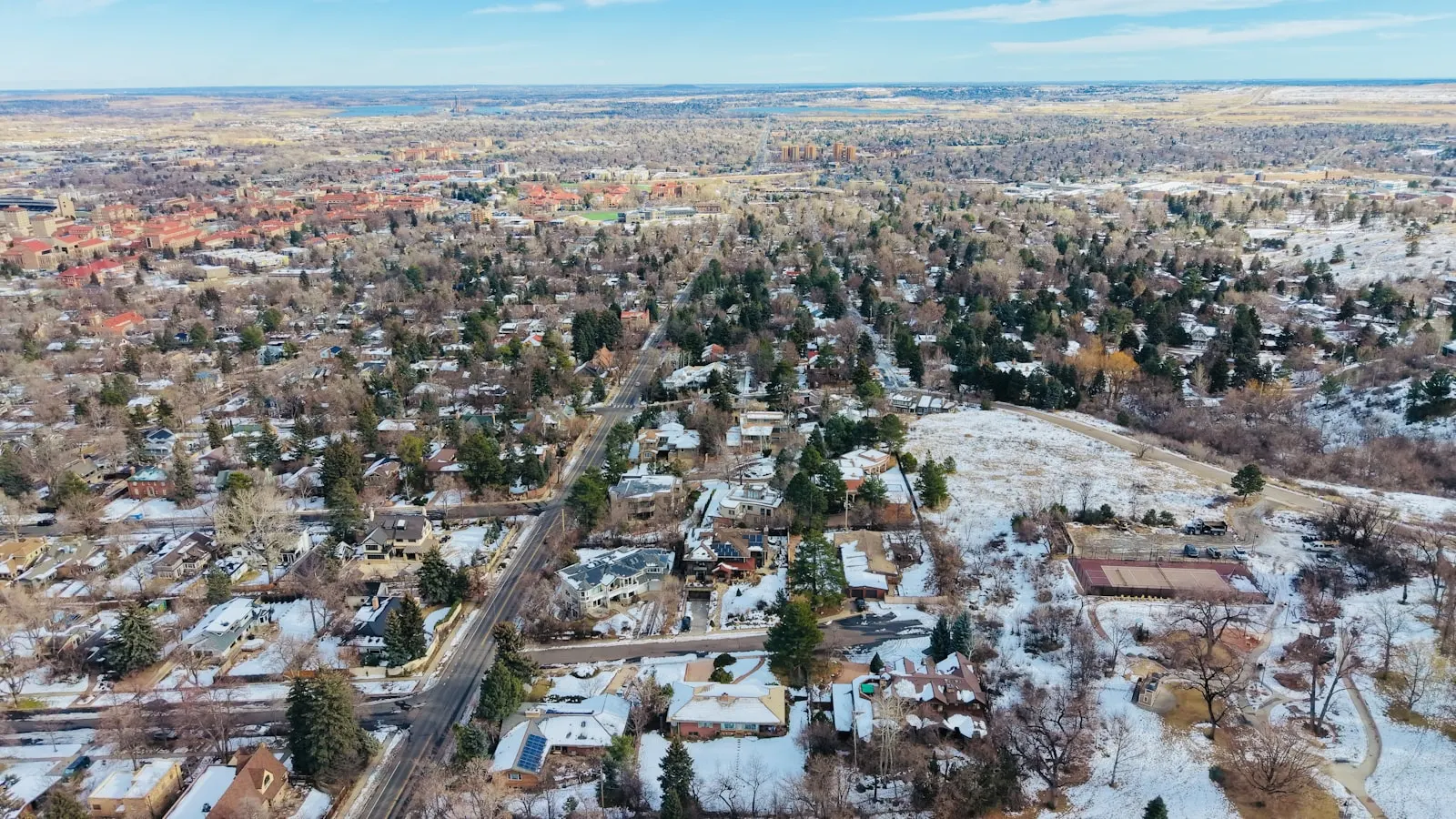
Boulder doesn't freeze one way. Upslope storms bury meters and vents under wet snow, Victorian walls hold no insulation at all, and cold air drains out of the canyon at night to pool along the creek. Your pipe is failing to one of those three, and the fix depends on which.
- Three freeze patterns, mapped
- Meters buried in upslope snow
- Safe thawing, never flame
- October 1 winterizing deadline
Three different ways Boulder gets cold
Frozen pipe repair in Boulder starts with figuring out which cold got you, because this city runs three separate freeze patterns and they call for three different fixes. The first is snow load. Boulder historically takes 80 to 95 inches a year, among the biggest totals in the metro, and upslope storms deliver it wet and heavy against the west side of everything. Meters get buried. Pit lids disappear. Exterior valves and vents vanish under a drift that crusts over and stays for a month.
The second is the buildings themselves. Houses from the 1890s through the 1920s were framed before insulation was a normal expectation, and plenty of Boulder Victorians still have exterior wall cavities holding nothing but air and a century of dust. A pipe run inside that wall is basically outdoors with a decorative cover over it. Balloon framing makes it worse, handing cold air a clear vertical path from the crawl space to the attic, straight past your plumbing.
The third is geography, and it's the one people miss. On clear, still nights cold air drains out of Boulder Canyon and down the creek corridor, pooling in low ground exactly the way water would. A house near Boulder Creek can sit several degrees colder than one up on Mapleton Hill under an identical forecast. If you're creekside, plan your winter around a colder number than the forecast prints. That gap is real, and it collects on you in February.
Where the old houses give up first
It's rarely the original house that freezes. It's whatever got bolted onto it. A kitchen or bathroom hung off the back of a Victorian in 1955, sitting over a shallow crawl space, with the supply line stapled to the coldest surface in the building because that was the shortest path to the sink. Rubble stone and brick hold no warmth at all, and crawl space vents that nobody closed in November feed canyon air straight across those runs. One room in an old Boulder house is always colder than the others. If that room has water in it, you already know your weak point.
Rentals near CU have their own version, and it's a calendar problem. The house empties out in mid-December, everybody flies home, and the thermostat gets set to whatever the last person out the door decided was thrifty. Three weeks later somebody returns to a split line in an uninsulated back-porch bathroom. This happens every winter in this town, and one text message plus a thermostat left at 55 prevents nearly all of it.
South Boulder's mid-century stock fails at the perimeter instead. The washer line crossing an unheated garage. A hose bib from the era before frost-free sillcocks were the default. One supply run threaded through an exterior wall by a 1958 framer who wasn't thinking about it. Different decade, identical physics: still water sitting next to cold loses, given enough hours.
| House type | The usual freeze point | The fix that holds |
|---|---|---|
| 1890s-1920s Victorian | Back-addition line on an outside wall | Seal crawl vents, insulate or reroute the run |
| Balloon-framed old house | Pipe inside a hollow exterior wall | Air-seal the top and bottom of the cavity |
| CU-area rental | Empty house over winter break | Thermostat at 55 and a scheduled check-in |
| Mid-century south Boulder | Garage laundry line, old hose bib | Frost-free sillcock, insulate the garage run |
| Creekside block, any era | Crawl space sitting in pooled cold air | Treat the forecast as several degrees colder |
Thawing a line without setting the house on fire
If a faucet goes dead on a January morning, work in order. Open that tap first, so melting ice has somewhere to push. Locate the coldest reachable stretch between the meter and the dead fixture, which in these houses means a crawl space, a rim joist, or the back wall of a sink cabinet. Then bring heat slowly, starting at the fixture and moving toward the ice: a hair dryer on low, an incandescent work light parked nearby, hot towels wrung out and re-wrapped every few minutes. Look for frost on the pipe. It usually marks the plug.
Never bring flame near a frozen pipe. In a balloon-framed Boulder Victorian, with a century of dry framing and open wall cavities acting like chimneys, a torch turns a plumbing problem into a fire department problem. A heat gun in a hurry isn't much better. Before you start any of it, stage a bucket and towels under the run and make sure you can reach the main, because ice letting go over a cracked fitting floods a room faster than you can walk downstairs.
Know when to quit and hand it off. Ice you can't find, pipe you can't reach, or a frozen run buried in finished drywall belongs to somebody with a thermal camera, and Front Range pricing on a thaw that ends without a split usually sits in the low-to-mid hundreds. Once the pipe has actually split, the bill tracks access and how much wall came down with it. Make the repair decision looking forward: a split in an open basement ceiling gets patched and forgotten, while that same split in a back-addition crawl space is the argument for moving the line somewhere warm while the cavity is already open.
Open the faucet, warm the pipe from that end backward, and never use flame inside an old Boulder wall. Stop the second you see water and close the main. Then treat the freeze as free information, because that pipe just told you where the house is weakest, and insulating or rerouting it now costs a fraction of doing this again next February.
Dealing with this in Boulder?
Start a quoteYour winterizing dates, already picked for you
Boulder's dates do the scheduling. First freeze historically arrives near October 1, first snow around the 10th, last spring freeze roughly May 7. That puts hose removal and sprinkler blowouts in the final week of September, not the second week of October when a neighbor finally books theirs. At the other end, anybody charging an irrigation system in mid-April is betting against seven more weeks of freezing nights.
Between those dates the routine is short. Crawl space vents closed by early November. Cabinet doors open under kitchen and bath sinks on single-digit nights, especially against outside walls. A pencil-thin trickle at the most freeze-prone faucet when a serious cold snap is forecast. And after every big upslope storm, clear the snow off your meter pit, your hose bibs, and any sidewall vent, because a buried meter becomes a problem the day somebody needs to shut it.
Landlords, put the winter-break check in the lease. Tenants, ask for it. If a line does let go while nobody's home, the emergency page covers the first five minutes in order. Up north, Longmont gets similar freeze dates with far less canyon influence, which is a useful comparison if you're wondering how much of this is pure geography. The full picture for your house sits in the Boulder plumbing guide.
Keep exploring
More for Boulder and nearby
All Boulder plumbing guides Frozen Pipe Repair across the Front Range Superior Louisville
Questions we actually get
Frozen Pipe Repair in Boulder: quick answers
What temperature actually puts Boulder pipes at risk?
No single number does it, because exposure decides everything. A well-buried interior line can sail through a subzero night while an uninsulated Victorian wall cavity quits somewhere in the low twenties. What matters is how long the cold holds and where the pipe sits: a creekside crawl space collecting canyon air, or a run behind an outside wall with nothing in the cavity. Duration beats a single sharp low.
Should I shovel out my water meter after a storm?
Yes, and most people never think of it. Boulder's upslope storms drop wet, heavy snow that packs hard around meter pits and exterior valves, and a lid you can't find is a lid nobody can open in a hurry. Clear it after each big storm along with your hose bibs and any sidewall vent. It takes about three minutes and it matters exactly once.
The pipe thawed on its own and nothing leaked. Am I done?
Check it under pressure before you relax. Ice can open a hairline separation that stays shut while the plug is still in place and only starts weeping once flow comes back, so run that fixture hard and eyeball every joint you can see for a day or two. Then act on what the freeze told you, because that run just identified itself as the weakest spot in the building.
Frozen line at your Boulder place?
Tell us which fixture stopped, what kind of house it's in, and whether you've seen water yet. We'll get it to plumbers who work these old walls.
Get My Free Quote