
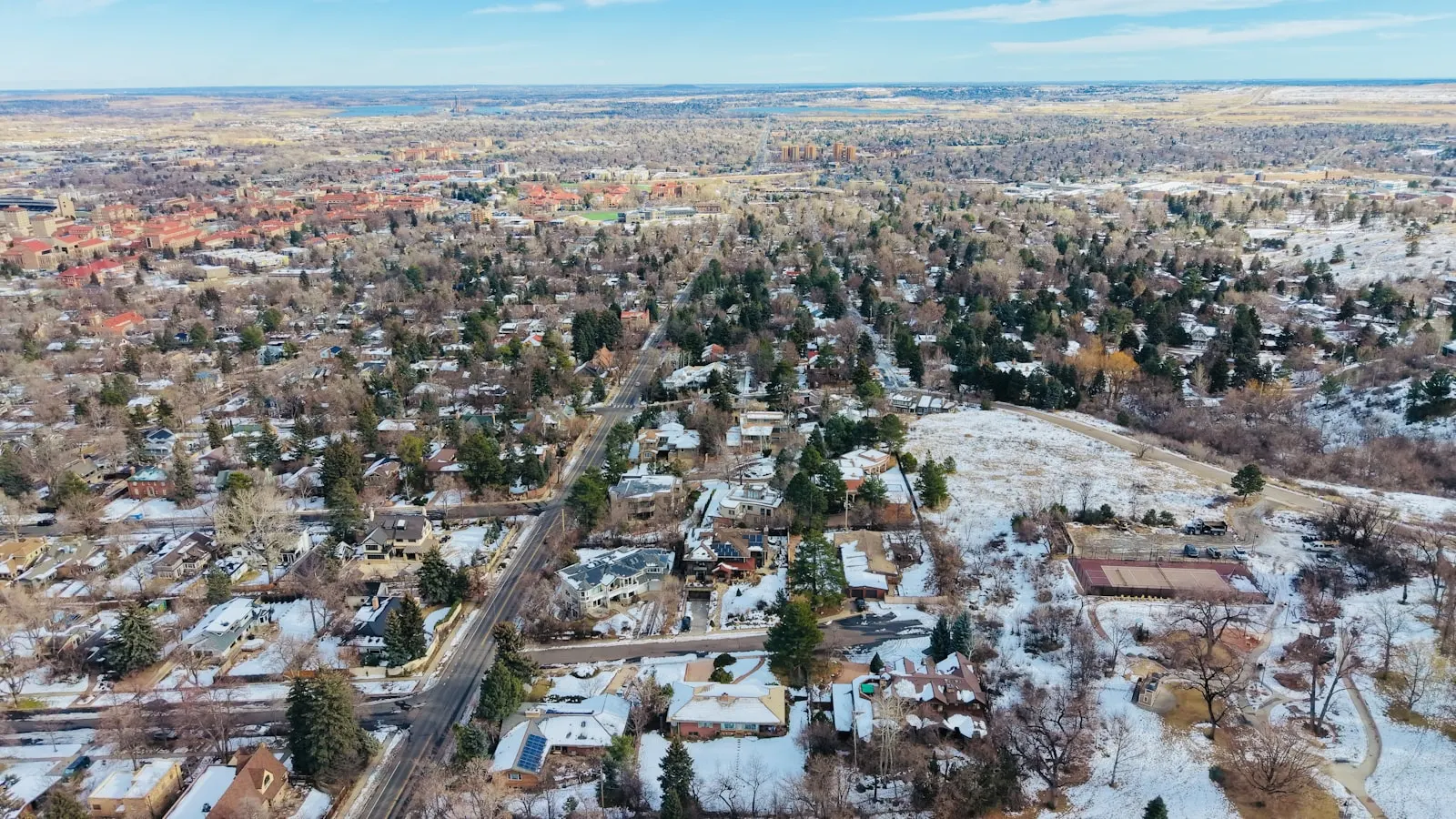
Freeze season starts here in September
Frozen Pipe Repair Golden CO
Pipe Thawing, Burst Repair & Freeze Prevention
Golden's first freeze historically lands around September 30, and the wind out of Clear Creek Canyon makes 25 degrees behave like 10. Slopeside crawlspaces and 1905 cottages take the worst of it. Here's where pipes actually freeze in this town, and what to do the night it happens.
- Wind-driven freeze risk
- Crawlspace and cottage weak spots
- Safe thawing, no torches
- Burst repair cost ranges
Wind does what cold alone can't
Still air insulates. Moving air doesn't. A pipe in a 20-degree crawlspace with no airflow can hold above freezing a long while on nothing but the heat leaking out of the floor above it. Send a 30 mile per hour chinook through the vent beside that pipe and the same 20 degrees strips the heat off it in a fraction of the time.
That's the piece people miss about frozen pipe repair in Golden. The calls don't line up with the coldest nights on the thermometer. They line up with the windy ones, and this town sits in the mouth of a canyon that funnels wind straight out over the neighborhoods below it.
So the risk map isn't about temperature alone. It's about which walls face the canyon, which crawlspace vents are open, and which pipe runs sit in the path.
A homeowner who closes two vents on the west side of a slopeside crawlspace in October has done more for their plumbing than one who wraps every line in the house and leaves the airflow alone.
Where Golden pipes actually give up
Hose bibs lead the list every single year, especially the ones on the uphill face of a house where nobody walks. A frost-free bib still fails if a hose was left attached, because the hose holds water against the valve seat out past the frost line. That's the classic September mistake, and a first freeze around September 30 catches people who are still thinking of it as summer.
After that: crawlspace runs near a vent, supply lines inside an exterior wall on a house built before insulation was a habit, pipes above an unheated garage on a slope, and anything added later. Miner cottages are full of that last category. Plumbing retrofitted into a house from 1905 goes where it can, and where it can is frequently an outside wall.
Kitchen sinks on exterior walls freeze more than any other interior fixture. Opening the cabinet doors on a cold night is a real trick, not folklore.
One more pattern worth knowing: a pipe that froze once will freeze again in the same spot. Heat loss doesn't wander. If a line gave you trouble last February and nothing about that wall or that vent has changed since, mark the spot and deal with it in September.
- If one faucet trickles and the rest run fineLocalized freeze, start thawing that run right now
- If nothing runs anywhere in the houseThe freeze is near the main entry, shut the water off and call
- If a hose is still attached in OctoberTake it off tonight, that bib is on borrowed time
- If a crawlspace vent faces the canyonClose or block it before the first hard wind, not after
Thawing it safely, and what a burst costs to fix
Open the faucet that the frozen run feeds. That gives melting ice somewhere to go, and it tells you the second flow returns. Then apply gentle heat starting at the fixture end and working back toward the cold section, so the water you free always has an open path out ahead of it. A hair dryer, a heat lamp, or a space heater aimed at the area all work. Heat tape works too, if it's rated for the job and not layered back over itself.
No torches. Not on copper, not on anything, and never in a crawlspace full of insulation and dust and dry framing. House fires during cold snaps are frequently thawing attempts, and a plumber's bill is always cheaper than a fire.
If a pipe already split, you'll know the moment it thaws, because the water arrives all at once. Keep the main shutoff reachable the whole time you work. If you're not certain where it is, go read the emergency steps and find the valve before you apply any heat at all.
Cost, hedged honestly: one accessible burst section repaired in an open basement commonly lands in the low-to-mid hundreds along the Front Range. The same split inside a finished wall, or at the far end of an 18-inch crawlspace on a hillside, costs more, because of the access and because somebody has to open and close the wall. Several failures after one hard freeze, or a run that needs replacing rather than patching, moves into the thousands. Water damage restoration is a separate bill, and usually the bigger one.
| Location | Why it freezes | What helps |
|---|---|---|
| Hose bib on the uphill wall | An attached hose holds water past the frost line | Disconnect hoses by late September |
| Crawlspace run near a canyon-facing vent | Wind strips heat faster than still cold does | Close the vent and insulate the pipe, not just one |
| Kitchen line in an exterior wall | Retrofit plumbing in a pre-1930 cottage | Open cabinet doors, add wall insulation later |
| Line above an unheated garage | Slopeside garages stay cold all season | Insulate the bay and seal the door gaps |
Dealing with this in Golden?
Start a quoteGetting a 120-year-old house through a Colorado winter
You can't rebuild a miner cottage into a modern house, and you don't have to. Freeze-proofing is a short list done well: hoses off, exterior valves drained, crawlspace vents managed, the two or three genuinely exposed runs insulated, and enough heat kept in the house that the walls stay above freezing while you're away.
That last one catches people who set the thermostat to 50 and leave for the holidays. In a well-insulated house out on the flats, 50 is probably fine. In an uninsulated 1905 cottage with wind coming off the canyon, an indoor air temperature of 50 can still leave a pipe in an exterior wall sitting below 32. Set it higher, and leave the cabinet doors open.
The season is long here. First snow near October 10, last freeze around May 7, and 60 to 80 inches of snow in between. That's more than half the year with freeze risk on the table.
So do the work in September. It's one Saturday afternoon, and it beats a February phone call. If you're comparing notes with people over the hill, Arvada's freeze pattern runs a bit later and a lot less windy, and the Golden plumbing overview covers what else this terrain does to a house.
Keep exploring
More for Golden and nearby
All Golden plumbing guides Frozen Pipe Repair across the Front Range Arvada Lakewood
Questions we actually get
Frozen Pipe Repair in Golden: quick answers
Why do my pipes freeze on nights that aren't that cold?
Wind. A canyon-mouth town gets airflow that pulls heat off pipe far faster than still air at the same temperature. A 25-degree night with a chinook blowing through an open crawlspace vent is harder on a supply line than a calm 10-degree night. If you only do one thing before winter, manage the vents that face the canyon.
When should I disconnect my hoses?
By the last week of September. The historical first freeze here lands around September 30, earlier than most of the metro, and a hose left on a frost-free bib defeats the whole design by holding water against the valve. Drain the hose, coil it, and while you're out there check that the bib actually drains when you shut it off.
Is it worth insulating pipes in the crawlspace?
Yes, but in the right order. Air sealing and vent management come first, because insulation on a pipe only slows heat loss, it never adds heat. Wrap the runs nearest exterior walls and vents, use sleeves sized to the pipe so they actually close around it, and don't bury a run so deep that warmth from the house can't reach it at all.
Frozen line in Golden?
Tell us which fixtures stopped and where the cold is getting in, and we'll get you to somebody who thaws these houses.
Get My Free Quote