
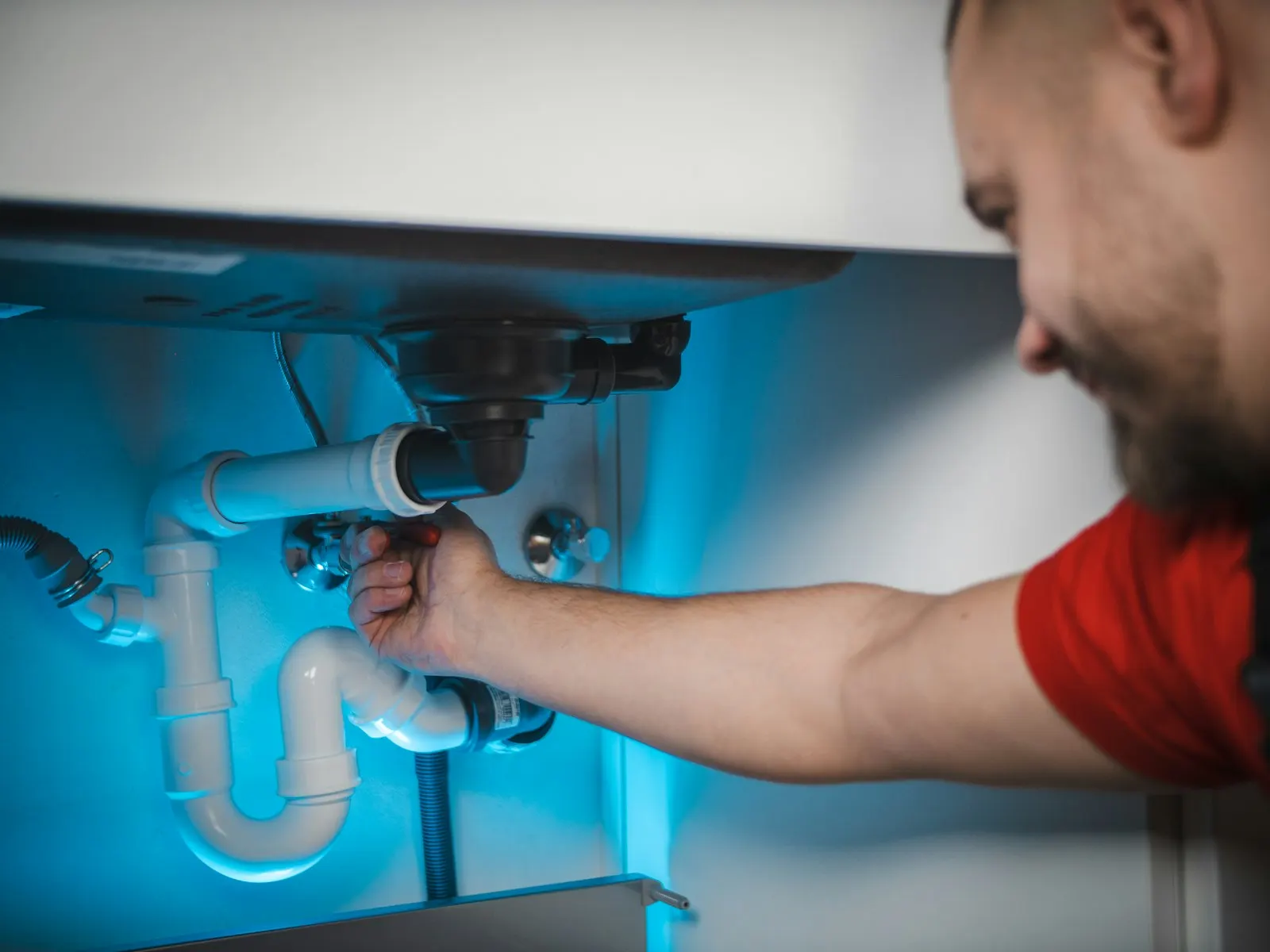
When it can't wait until Monday
Emergency Plumbing Lakewood CO
Burst Pipes, Active Leaks & Water Shutoff Help
A city with this much 1950s and 1960s inventory has a lot of original valves in it, and original valves fail on their own schedule. Usually at night. Usually in a tri-level where the shutoff hides behind the furnace. Know where yours is.
- Find your shutoff tonight
- Tri-level mechanical layouts
- Hogback wind freeze calls
- Fast quotes, day or night
The first ninety seconds
Emergency plumbing in Lakewood is mostly about the first minute and a half. Water leaving a pipe under pressure does damage on a curve, not a line, so what you do before anybody arrives matters more than how fast they get there. Shut the water off. Kill power to anything the water can reach. Then call. That order, every time.
Fixture shutoffs come first if the leak is at a toilet or a sink: the small oval or lever valve on the wall behind it, turned clockwise. If that valve is original and won't move, don't force it into snapping off in your hand, because a stuck stop that breaks becomes an open pipe. Go to the main instead. In the postwar houses it's usually on the basement wall facing the street, often near the meter, often behind a shelf. In the tri-levels and Green Mountain builds it's frequently in a mechanical closet, a crawl access, or a corner of the garage.
For a water heater failure, shut the cold inlet valve at the top of the tank and cut the gas or the breaker. For a burst line inside a wall, hit the main and then open the lowest faucet in the house so the remaining pressure drains out low instead of through your ceiling. Buckets and towels are for after all of that, not before it.
Know your shutoffs before the wind picks up
Every house here has three or four valves that matter, and the afternoon to find them is a calm Sunday in October, not a Tuesday at midnight in January with your phone flashlight in your teeth.
Gate valves are the quiet villain in this city. They're the round-handle valves standing in older homes all over the west side, and after decades of never being turned they either seize solid or shear off at the stem the moment you finally need them. Turning each one twice a year keeps them honest. Swapping the worst of them for quarter-turn ball valves is a small scheduled job that pays for itself completely the first time something lets go.
Label what you find while you're down there. A strip of tape on the main, a tag on the water heater inlet, and a note on the panel about which breaker kills the furnace turns a panicked search into ten seconds of work. Anybody in the house should be able to do it, including the person who has never once thought about plumbing.
- Main shutoff: basement wall toward the street in postwar houses, mechanical closet or crawl in tri-levels and newer builds.
- Street-side curb stop: under a small metal lid in the parkway, and it needs a key most homeowners don't own. Worth knowing it exists.
- Water heater inlet: on top of the tank, cold side, and it's the one valve people forget under pressure.
- Fixture stops: one under each sink, one behind each toilet, and in a 1950s house roughly half of them are past their working life.
- Water is spraying and you can't stop itMain shutoff, then power off to that area, then call
- Toilet overflowing but not sprayingClose the stop behind it and stop flushing anything
- Sewage backing up into the lowest drainStop running water anywhere in the house right now
- No water at all on a cold nightAssume a freeze and stay near the main in case it splits
What emergency plumbing in Lakewood costs after hours
After-hours plumbing costs more, and the honest reason is that somebody is being paid to leave their own house at 11 p.m. Along the Front Range, emergency call-out fees commonly start in the low-to-mid hundreds before any repair happens, and the repair prices out on top of that. A burst supply line inside a wall is a different job than a failed stop at a toilet, and a water heater letting go at midnight is a different job again.
Some of it can wait, and a plumber who says so out loud is worth keeping in your phone. A dripping faucet at 9 p.m. is a Tuesday problem. A toilet supply line spraying at the same hour is not. The dividing line is simple: if you can isolate the water and the damage stops, you have time. If you can't isolate it, or if water is reaching finished ceilings, electrical, or the furnace, then it's now and the price is what it is.
Winter rewrites the math on the west side. A hard night with wind coming off the hogback fills every dispatch board in Jefferson County, so a freeze call in January is competing with twenty others while the same call in October gets someone within the hour. That isn't a scam, it's weather and supply, and it's the whole argument for handling freeze prevention in September when nobody is busy.
Dealing with this in Lakewood?
Start a quoteWhat can wait until morning, and what can't
Not every leak deserves overtime rates. A slow drip under a sink into a bucket, a running toilet, a hose bib weeping in July: those cost you a few gallons and can be handled in daylight for meaningfully less money. Close the local valve, put a towel down, go back to bed. That's a legitimate answer and a good plumber will give it to you.
Call immediately for anything with pressure behind it, anything where sewage is coming up instead of going down, any gas smell near the water heater or furnace, and any water near an electrical panel. Those aren't judgment calls at all. In a city carrying this many original systems, small failures escalate faster than people expect, because the thing sitting next to the failure is usually just as old and just as tired.
The best emergency work happens months ahead of the emergency: known shutoffs, a labeled panel, gate valves swapped for ball valves, and a tank replaced on your schedule rather than on its own. If you want to see how the same calls play out on the other side of Sheridan, the Denver page covers denser housing with a lot of the same vintage pipe.
Keep exploring
More for Lakewood and nearby
All Lakewood plumbing guides Emergency Plumbing across the Front Range Denver Wheat Ridge
Questions we actually get
Emergency Plumbing in Lakewood: quick answers
Where does the main shutoff hide in these houses?
In postwar and mid-century homes, look on the basement wall that faces the street, usually near the meter and usually behind whatever got stacked there. In tri-levels and the newer Green Mountain builds, check the mechanical closet, the crawlspace access, or a utility corner of the garage. Find it tonight, tag it, and clear the stuff sitting in front of it.
Do I really need somebody tonight?
If you can close a valve and the water stops, you can usually wait for normal hours and pay less for the same repair. If the water won't stop, if it's reaching electrical or the furnace, or if sewage is rising through a floor drain, that's a now call. The gap between overtime and normal rates is smaller than the cost of a soaked floor system.
Why do freeze emergencies spike here in January?
Wind off the hogback pulls heat out of west-facing walls much faster than still cold does, and cold air also drains downhill after dark and settles in the lower ground near Bear Creek. A night that reads as merely cold on the forecast can be considerably harder on an exposed pipe in either spot. Those nights fill every plumber's schedule at the same hour.
Lakewood emergency? Start here.
Close the valve first, then send us the address and a plain description of what let go, and we'll get somebody moving.
Get My Free Quote